Showing posts with label ephemera. Show all posts

Wednesday, April 23, 2014

Bookworm ripples

We learned earlier this week on Book Patrol, the long-time bibliophile favorite painting known as The Bookworm by Carl Spitzweg is coming up for sale.  Maybe.  Apparently there are three versions of the painting by Spitzweg.  The one potentially coming up for sale is currently held by the Milwaukee Public Library.  They have *not* come out and said they were definitely selling, just that it was something they were considering.

I wondered if this one was the one that hung at Leary's Book Store in Philadelphia.  Leary's is remembered fondly and well by throngs of bibliophiles, and many remembrances can be found online.  It closed in 1968 after operating for "nearly 100 years" and the building was torn down.   The quotes are because no one is quite 100% sure when Leary's was founded, but their history as a book selling operation certainly goes back well over 100 years.

Leary's has a long history, and its archives are preserved at Temple University.  I had no experience at Leary's being born a decade after it closed, very, very far from Philadelphia, but sounds like a place I would have loved to visit.  500,000 books?  Road trip worthy!

1893, Leary, Stuart & Co.
So I dug into my question about the painting, remembering it from Leary's related ephemera.  A cursory search online revealed (to me, and maybe I'm wrong!!), that Leary's didn't actually own a copy of the painting, but rather appropriated the image.  They had a stained glass window created for the store interior, and incorporated the image as a huge sign on the exterior of the building.  The sign, when sold at auction was acquired by the Gale Research Company where it went to Detroit.  I wonder if its still there.  Or with whoever owns Gale Research now.

1902, Leary, Stuart & Co.
I know I can't afford the Milwaukee library painting's auction estimate of $400,000 (and I wouldn't be surprised if it went for more), but nearly anyone can afford cool Leary's ephemera from their good-ol-days featuring the work!  
1955 postcard featuring The Bookworm
hung from mezzanine
On an unrelated note, I hope this post didn't frighten anyone thinking I was long gone.  I won't get into gory details (this is a book collecting blog!), but shortly after the last post in Dec. 2012 my life exploded, what remained imploded, and then flipped upside down.  I've been rebuilding since, wandering in exile.  I'll be landing in Lincoln, Nebraska (my hometown) this July, and hope to get settled in quickly, and maybe even get to posting here again on occasion!  I'd like that.


The Bookworm sign on the exterior of Leary's in 1920.

Wednesday, November 10, 2010

New, for Ephemera Lovers


I've admitted before that I love ephemera too, and I believe every book collection can be enhanced by including ephemera. There are some great ephemera focused sites already "out there", but there is one I've rather selfishly kept to myself, mostly out of envy of the site owner. Unlike my blog, his site is clean and organized and has amazing, fresh content several times a week. The blog owner, Saul, even has a mission statement (the organized, purposeful so-and-so):

"This site is devoted to the identification, preservation, publicizing, and study of ephemeral publications that provide more-nuanced pictures of American culture and life. Because intended to aid scholars as well as collectors, this site focuses on artifacts preserving obscure information and imagery. (It excludes already-familiar ephemera such as posters, labels, comic books, and most cards). The main feature of this site is a gallery of images chosen for their aesthetic and/or documentary value. "
So, if you're not already following Ephemera Studies, go check it out! And come right back!

Saturday, January 17, 2009

Update: Book Label Flickr Group


.

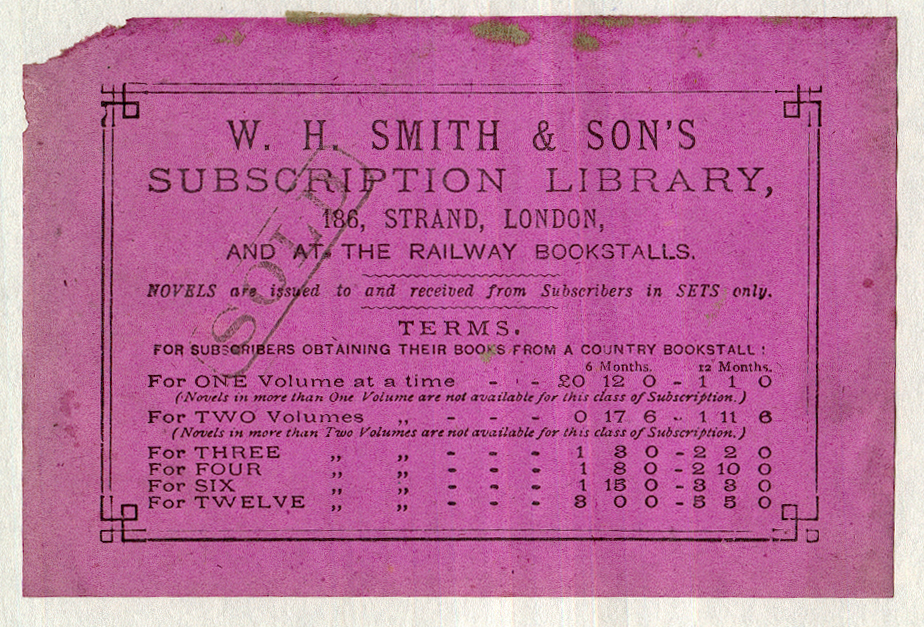
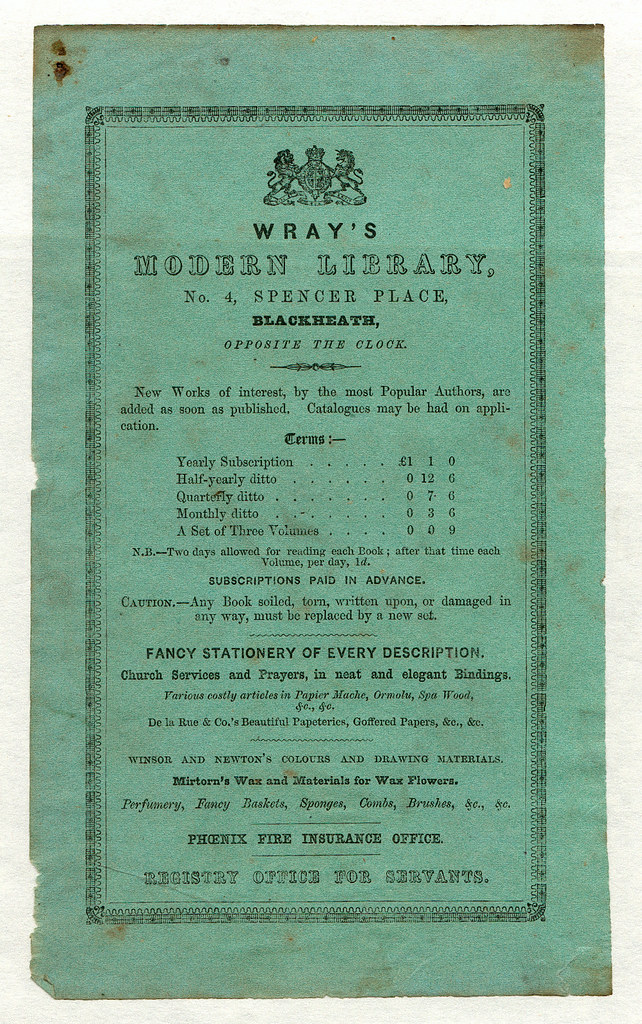
It's been a little over two months since the launch of the Flickr group Seven Roads Book Trade Labels. We're now up to 9 members, which is ok, but the very exciting bit is we have 376 labels up, with new additions every week. This week, we have this very nice label from WH Smith & Son's subscription library, detailing subscription levels, and how Smith's gave "more bang for your buck", or ha'penny or whatever ridiculous clap-trap the English were doing with their money back then. Loyal label poster alan.98 has posted a couple other lending library labels as well. I very much like the agricultural library, but the label from Wray's Modern Library takes the cake. As Alan points out in his posting to the group:

"What a wonderful shop this must have been — you could not only buy books and fancy stationery but take out fire insurance and hire your servants too. You had to be quick and read your books in two days, though."

Flickr memberships are free (if you have a yahoo account, you already have a Flickr account), so why not take a minute, join Seven Roads Book Trade Labels group and post some of the little book trade labels in your own collection?

Thursday, November 6, 2008

New Seven Roads Flickr Group


.
One of my favorite websites in the bibliosphere is Seven Roads Gallery of Book Trade Labels. It was this website that gave me the idea for the American Book Trade Index. It is a well thought out, attractive, well designed website. Sadly, it has been over a year since it was updated, and emailing Seven Roads webmaster has not yielded a response. Wanting to see more and more book trade labels, I went ahead and started a group on Flickr, under the name Seven Roads Book Trade Labels. The idea of this group is that anyone can post images of book trade labels, and it won't be on just one person to upload these little gems. As always, if you have some to trade or sell, let me know. That's how I became the new owner of these beautiful Dutch gems.

.

Sunday, October 5, 2008

Leopard Bikini Found in Book

Yep. Had another book safari for the ages. I found some great books for myself, but also found a book on Hawking. I'm not interested in hawking, personally. Don't get me wrong, training raptors to hunt for you is cool, but I already have too many hobbies.

However, if you're like me, there is never quite enough money for the books I want, so when I find other interesting books I know are collectible in their own right, I pick them up and send them along to more appreciative owners. For money.

Flipping through the book once I was home, I found a great flyaway. Flyaways are the little bits of stuff we leave in our books to be found later. Receipts, movie tickets, torn off bits are the norm, but I once found a chocolate chip and 30+ year old pornography. Not in the same book, though. Some old-time booksellers refer to flyaways as "hay" though more and more collectors, booksellers, and antique dealers now refer to it as ephemera.

I know you doubt it, but the post card is actually hawking related. The Rare Bird Farm in Miami Florida sent a message to the effect "No, we don't have hawks". Photo by Bunny Yeager. Now to decide if I should sell the postcard separate on ebay, or just leave it in the book where I found it for the next guy.

.

Monday, August 18, 2008

Recent Addition: Mennonite Book Store, postcard interior


.
Scottsdale PA, Mennonite Book Store, postcard interior
Store interior with press back chair in foreground, display cases and counters with books galore. Note the lighting fixtures suspended from the ceiling and, on back wall is an old wood frame wall telephone. Scottdale, Pennsylvania is in Westmoreland County near Mt. Pleasant, Upper Tyrone and Connellsville.

Robbins R-52721 - Circa 1915

Part of my collection.

.

Saturday, August 9, 2008

Weil - Ptak Ephemera Scale


Marty Weil of the The Ephemera Blog and John Ptak of The Science Bookstore have put together a useful rubric for measuring "ephemeralness". Marty says
"WP Ephemera Scale standardizes the relative indicators of what makes something ephemera into six principal categories and grades them on a scale of 5 through 30, least ephemeral to most. The indicators approximate the printed item's importance, distribution, susceptibility for being saved, durability, age, and purpose."

They then break down 5 categories, and assign a score (1-5) to the various attributes. So, 5 would be the lowest total score possible, and would be the most ephemeral item. A 30 would be the highest, least ephemeral thing. These include:
(A) Place of origin/population target. (Approximation of how many of these printed items were made.) What sort of population was it printed for? (5) town (4) region (3) city (2) state (1) country
One thing that could be very difficult to measure is (A) the quantity of an item printed. The target audience is a good, but rough guide. I can't think of anything as effective, certainly nothing more effective. I don't like that the evaluator needs to draw conjectures and extrapolate, but I think this may be as good as it gets.
(B) Amount of usage/intended amount of use of the printed item. (5) Single, one-time usage (implying it was collected after use/thrown away) (4) multiple (3) monthly (2) yearly (1) lifetime
(B) also perhaps needs more definition. For instance, how do I score something that was not expected to last very long, but expected to be used up over a few months? Is that multiple or monthly? Or is something "monthly" if I use it once a month?

(C) Purpose of the printed item. (5) Very highly restricted (1) very widely employed, multi-purpose

I think we need some things defined. Like (C), what is "highly restricted" intended use vs. multi-purpose? Like a matchbook- usually limited to the life of 20 matches (on a windy night, that could be very short), or is it multi-purpose? Are there degrees in the middle?

(D) Savability--reasons why the item might have been saved. (5) Very low (reason to save it, like an unused bus transfer, laundry ticket; OR, the item was collected after use; (4) Low (intended for a single use but was not necessarily collected once used (like a movie stub); (3) Medium (2) High (1) very high reason to save (like wedding photos, military troop photos, baby pictures, that sort)
(E) Medium (the physical object itself and the stuff it is made of, meaning that if it was flimsy, toilet-paper-like material it would just not stand the test of time better than, say, a vellum document. It was made to be dispensable.) (5) Flimsy, potentially volatile material; (4) newsprint (3) cheap paper but better than newsprint (2) strong, good book-paper (1) very strong (vellum, thick, cover-stock paper
(F) Age. (5) New (4) Newish to 5 years old (3) 6-25 years old (2) 26-100 years old (1) 200+ years old


I believe (F) is supposed to score the other direction, but you get the idea. So, I want to put the WP Scale to test and see what there is to see.

This scale is really wonderful and it is certainly evident a lot of thought and consideration has gone into it. I think it will be a helpful tool, especially to people who do not deal much with ephemera, to understand what makes a piece special. It could also be very helpful to collection managers and archivists to help quantify the scarcity of ephemera in museum and library/archive collections. Another thing I like, is that to use the scale, you have to have the object in your hands. This cannot be done by photos, or arbitrarily they way many booksellers grade their books.


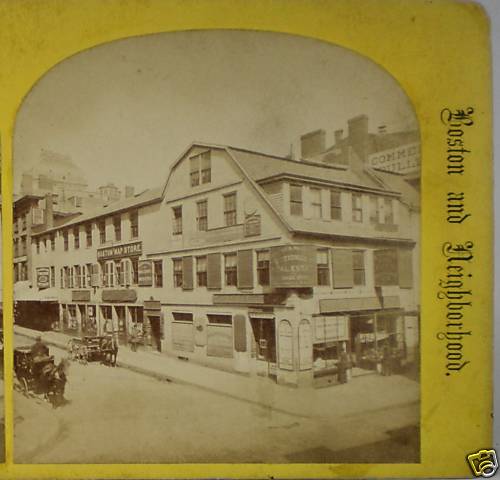
OK, so let's apply the scale to a stereoview I just bought this last week or two. It is an image of the Old Corner Bookstore in Boston.

A) I've seen this stereoview a few times before, and know this was an oft-printed series. I would rate it a 3. I think 3 is too high, perhaps 2 should be for states and large cities. Afterall, the population of Boston in the 1870s was bigger than some of the more rural states.

B) Amount of usage. I think a 2, yearly. I don't think stereoview publishers thought these would last a lifetime, but were intended to last a long time.

C) 1. Stereoviews were meant to be used many, many times in the home, or at a reading room, school, etc.

D) 2 for savability.

E) 1 for medium. Stereoviews were often printed on very heavy cardstock, but quality varies. My example is on one of the nicer stocks.

F) 4. The stereoview has a handwritten date on the back of Nov. 1872, in period brown dip-pen ink. It was black ink, but it turned a very dark brown after 130+ years of oxidation. The date also fits the style of stereoview.

So, the WP Ephemera Score for my stereoview would be: 13. For this particular stereoview, I think this is a good score and reflects the ephemerality of this item. I've told you before, I'm not above making up words.

Tuesday, April 8, 2008

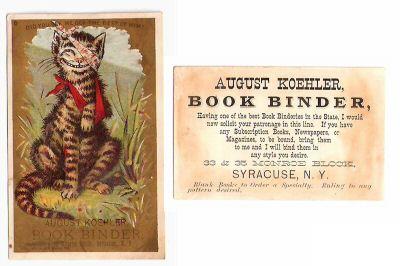
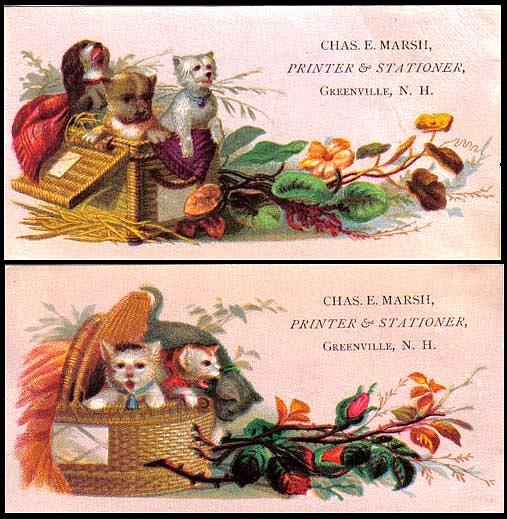
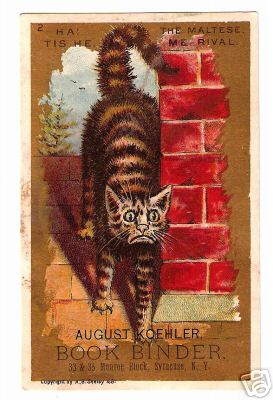
Book Shop Cats

.
Why do all used book stores have cats? Don't tell me any reasons that explain how wonderful cats are. No. Cats are... well, they're a lot of things, but one thing for certain: they are not for me. People don't own cats, cats retain you for their staff.

I think at least half of all used book stores have cats. Stores without feline tenants are over compensated for as it is rare to find a catty bookstore without several creatures within. So, my conservative estimate is that there are at least 3 bookselling cats for every used and antiquarian book shop in North America. If you think you can escape cats in books about bookshops, well the ratio in fiction is at least 12:1! Now, this is all based on years of extensive research and a dislike of cats.

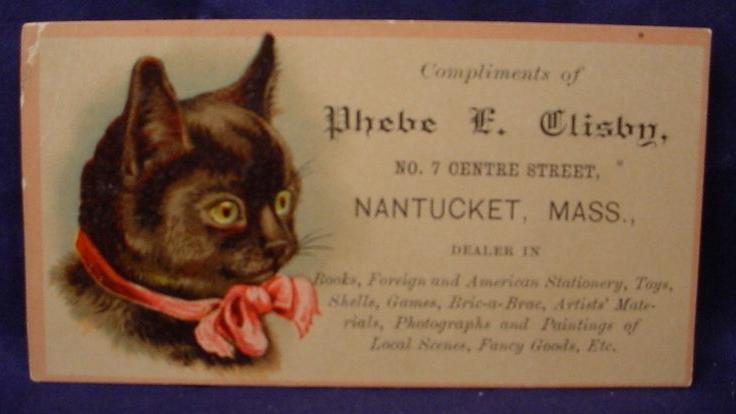
Before the bibliocommunity starts heating up the tar and plucking chickens, I offer these: 19th century trade cards featuring cats. These cats aren't too bad. They're mostly cute, they don't shed, don't make a racket or *ahem* mark territory.

Since nearly all of my readers (well, both of you) are "cat people" I post the following for your viewing pleasure. Of course, these are only a few contributions to the American Book Trade Index, which churns on. We are currently closing in on the 1800 image mark! Hooray!

Friday, January 11, 2008

AA and Ephemera Collecting


A recent arrival for my collection. Typically I buy items and put them away once a decent image is uploaded to the American Book Trade Index. Then I'll go back and poke around, recording details as I can find in bibliographies and Google. Blah, blah, blah, but it is a lot of fun, and odd things turn up. This advertising cover is a great example.

Some details: 1875 is in the round part along the roof line of the building. What's that round bit of wall that sticks up called anyway? The sign at the top of the building says "Rialto Block". A sign below the top row of windows reads "Journal Bindery". The address under the engraving says "State St., Montpelier, Vt.". I looked a bit for a Clarks Journal in Montpelier, and didn't find much. A JD Clark is listed as a bookbinder on the Rialto Block in an 1887-8 Directory. So, according to the cancellation mark on the cover, and the directory, we can place Clark-Journal Bindery at least from 1883-1888.

I thought I would try looking for the addressee, a Judge Walter P. Smith. Well, it turns out he's the father of Robert Holbrook Smith. Robert H. Smith is generally known as Dr. Bob, one of the founders of Alcoholics Anonymous. The enclosure from the envelope is long gone. I imagine it would have been a bill or a quote for binding ledgers or some such thing. The Clarks Journal sounds like a bindery attached to a newspaper. These kinds of operations did a lot of ledger and similar binding.

So, does the Rialto Block on State Street still stand in Montpelier?