Showing posts with label book trade labels. Show all posts

Friday, June 19, 2020

Book Trade Labels

Book Trade Labels, Bookbinder Tickets, Bookseller Chits

They have a lot of names. I've come to group them all under the phrase "Book Trade Labels" to encompass booksellers, bookbinders, stationers who sell books, etc., ad inf.

That said, if you have any of these little guys, collect them, or just happened across them, let me know! Also, I love to collect them, so if you have a duplicate or a whole collection, LET ME KNOW. If you're kind of new to it and want to swap, ... you get the idea now, right?


PS, This blog is no longer actively updated. Go check out my current website: benjaminlclark.com

Saturday, December 8, 2012

The Mystery of Cloomber - A Conan Doyle

It's *pouring* snow here in my little corner of Montana this morning.  Was only supposed to be a skiff of snow, but it's at least 4" of heavy stuff and still pouring down.  It's a good day to take a minute and find my next read.  Like many bibliophiles, I can't help but turn to British "classics" in winter.  I'm not sure what it is. Some sense of nostalgia for a place and time I've never experienced first-hand must have something to do with it.  No matter, I don't have to understand it to enjoy it.  Personally, it's not Dickens at Christmastime, but Conan Doyle's Sherlock Holmes, and PG Wodehouse that usually accompany me before my winter's naps.  A recent find was this unknown to me book The Mystery of Cloomber.  I know nothing except a man (Santa?) is horrified by what he hears.  I also happen to know this copy was once in West Virginia.  
This copy includes a great book trade label from Bluefield Book & Stationery Company in Bluefield, West Virginia.  Like many book stores approaching the 20th Century, they also sold other goods, like cut glass, china, office equipment, stationery along with "All The Latest Books."  I also wonder if this book was in a subscription library of some kind with the contemporary numbered label in the upper corner.  Now, where did I put that list?


Like this?  Subscribe to my newsletter.

Saturday, December 3, 2011

Book Trade Labels spotted!

It's been a while since I've posted on book trade labels, but believe me, they are never far from my heart.  Over Thanksgiving, the Mrs. and I took a pleasant trip to visit friends and our old stomping grounds in Oklahoma.  Luckily for me I was able to  include nearly all the surviving used and indie bookshops in Oklahoma City-- and a new one!

I made quite a haul home in my suitcase, and had to ship a goodly sized box back to Montana as well.

One of the books I bought on an impulse was Barbara Hodgson's The Tattooed Map.  What initially caught my eye on the Clearance shelf at the new Half-Price Books in Edmond, OK was the Chronicle Books colophon on the spine-- these folks put out wonderful books.  Always worth a flip through at the very least.

What a surprise when I did. It was a constant flow of beautiful ephemera reproduced throughout.  Then, closer to the back, bookseller labels started popping up.  I include here only three of the six.  They came out a little blurry.  I think my scanner is just too much for my rickety desk and that's what's causing that.  They really are beautifully reproduced in the book.  I found myself running my fingers over things and surprised it wasn't pasted in.

Maps, books, and ephemera play an important role throughout the story, although it really isn't about that.  Newspaper clippings, receipts  business cards, fold out maps, are complimented with exact details (like library stamps on the backs of maps) and handwritten lists and notes throughout.

As a story, it didn't blow me away, but it's gotten better in my mind with a few days of perspective.  Hodgson has produced a few other books described as Illustrated Novels along similar principles, but this was my first.  Hodgson's more recent book, Trading In Memories, about being an ephemera hunter, has moved from my "Acquire On Sight" list to "Acquire Now" list.


Like this?  Subscribe to my newsletter.

Monday, September 12, 2011

1990s, Borders Book Shop, gift label

It sounds like this is the final week for Borders stores to be open. I happened to find this tiny label last week amongst some books for another project I'll talk about more soon. It was used to cover the printed price on the back of a trade paperback-- I imagine they were used inside dust jackets as well at that time-- my book was from 1992 (iirc). Really a tasteful solution to keep people from price clipping dustjackets or gouging off prices off the rear cover of a paperback. Now in my collection of book trade labels, though a little different. I like it. Anyone ever seen different varieties? Anyone seen a price-cover-up sticker/ label from another bookshop?


Like this?  Subscribe to my newsletter.

Thursday, December 30, 2010

Full of Books

Burligton Iowa, I'm sold! Book dated 1883. I'd certainly go see if it were true or merely bold talk.

From
Love's Book Store
Full of Books
and
Elegant Goods
Hedges Block
Burlington, Iowa

Tuesday, December 28, 2010

Fantatic new website


One of my very favorite areas of the bibliofilic world is book trade labels. I have a modest collection I'm pretty proud of. There are a few websites devoted to these gems of the book world, and now there is another, http://www.booksellerlabels.com/ Gabe Konrad of Bay Leaf Used & Rare Books has put together a wonderful site with lots of great information all gathered into a convenient, useful site.

He sorts through some of the questions of what is a book trade label, provides a very useful list of references, even providing links to how he had some labels made for his own shop.

The image to the right is a few of my own labels I've printed as a postcard. I'm thinking of doing a series.


.

Sunday, March 8, 2009

Book Trade Labels redux

Below is my latest post on the Fine Books & Collections blog. Sorry about phoning this one in here. PS, I did get my neato postcard in the mail today for the booksale at UCO in Edmond, April 17-19. I'll post more on that soon.


One area I collect in is books about books. A part of that collection includes book trade labels. What is a book trade label? If you've handled old books, you've likely noticed teeny-tiny labels typically on the front or rear endpaper. They will often be less than an inch long and a half inch tall.

I'm not really sure why, but it seems more natural to refer to these tiny bits of paper as tickets when associated with a bookbinder, and a label when it is from a bookseller. Perhaps because craftsmen use jobbing tickets and retailers label their merchandise. In the interest of casting my net wide, I refer to them all as book trade labels. That was the nomenclature used when I found Seven Roads Book Trade Labels and realized I was not the only one interested in these gems. Unfortunately, Seven Roads went dormant in June 2007. However lost Seven Roads is, we gained the Bibliophemera blog, which often features labels.

Book trade labels were used by booksellers, bookbinders, and can be a wealth of history and fun. Labels, historically, were available from commercial label printers. However, some specially made labels could set a bookseller apart from others near by. This 1891 advertisement from James Clegg in London gives just a few examples of common types. I'm currently working on a "field guide" to book trade labels and advertisements like Clegg's are golden discoveries. Some booksellers today use custom return address labels, which are certainly effective, but can be ho-hum. I've not seen any contemporary "bibliomorphic" labels like this one from Oklahoma City


Last week I received a new label for my collection from Scott J. Coutts at Solidus bookbindery in Melbourne, Australia. Scott is honestly the first active bookbinder I've met who has decided to use a label to identify his work. Deciding to use one, he went all out to make it memorable. He used the image by woodcut artist Jost Amman of bookbinders at work in the 1568 work A True Description of All Trades.

Scott, a microbiologist working at Monash University in Melbourne, Australia, decided to take up bookbinding about a year and half ago.

Exile Bibliophile: What drew you into bookbinding?

Scott: I've always loved good books, particularly photography books. Also, I'm often annoyed at how badly constructed modern books are! I like old things and things that have a certain 'charm' and sentimental value, things that are quite tactile - especially books, which I collect. So I guess the love of well-made books, my annoyance with badly made books attracted me to binding . It's a creative outlet.

Exile: What spurred your decision to create your own label?

S: I've always liked ex libris and book trade labels. Since I started making my own books, I thought it was reasonable that I should have my own! Primarily, I like the look of them. As you can tell, my labels contain no contact information so, for better or worse, they're not really designed for advertising or increasing sales (maybe they should be!)

Exile: I think they're memorable enough! Could you describe the process you used to create your label? Are they letterpress printed?

S: The actual labels are not printed traditionally, only because I don't have the means. The label was prepared digitally and printed with an inkjet printer. I didn't use coated paper on purpose - In this instance, I like the small amount of bleed that occurs. The paper is Van Gelder Zonen 120gsm laid paper, which is one of my favourites! After printing several to a sheet, they were torn down using a 'deckled edge tearer ' to produce the irregular edges. Finally, the edges were boned flat and smooth, ready for use.

Exile: I really like the deckled edge effect, and was impressed with your method. I've never seen a label featuring a deckled edge. I have some perforated labels, but nothing like this. Thank you for the beautiful label for my collection. I'm sure it will stand out for a very long time!

Saturday, January 17, 2009

Update: Book Label Flickr Group


.

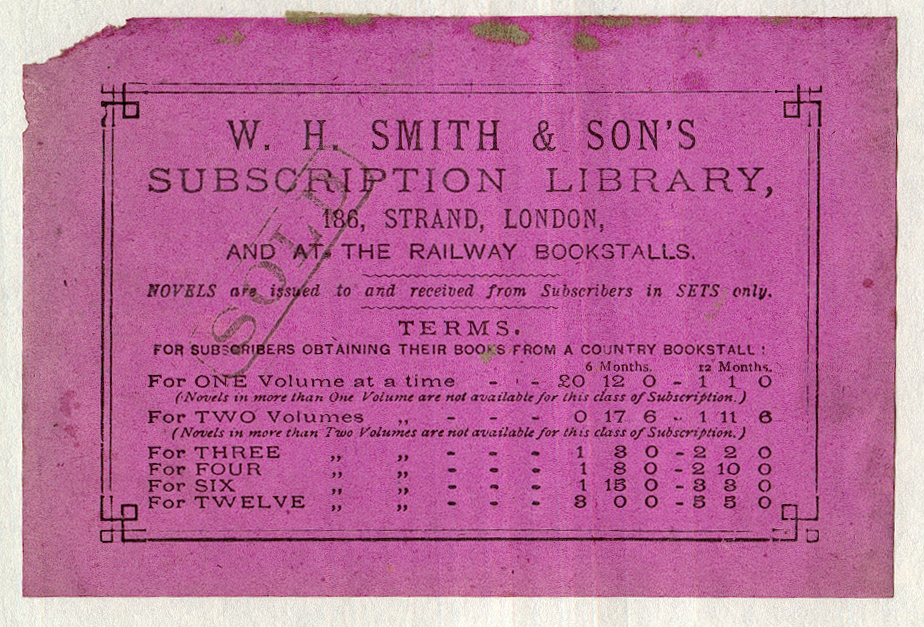
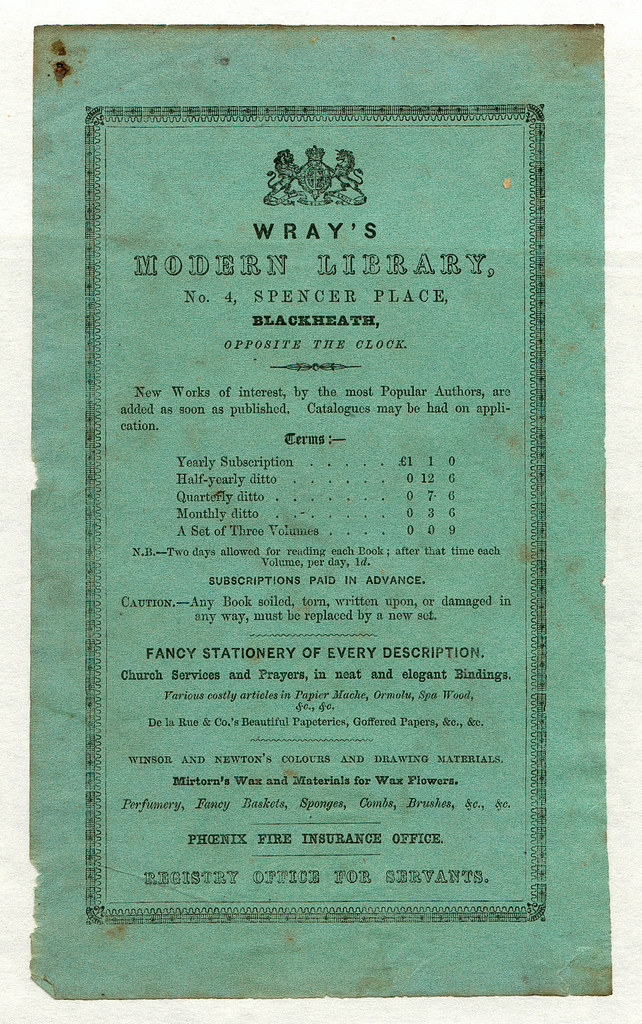
It's been a little over two months since the launch of the Flickr group Seven Roads Book Trade Labels. We're now up to 9 members, which is ok, but the very exciting bit is we have 376 labels up, with new additions every week. This week, we have this very nice label from WH Smith & Son's subscription library, detailing subscription levels, and how Smith's gave "more bang for your buck", or ha'penny or whatever ridiculous clap-trap the English were doing with their money back then. Loyal label poster alan.98 has posted a couple other lending library labels as well. I very much like the agricultural library, but the label from Wray's Modern Library takes the cake. As Alan points out in his posting to the group:

"What a wonderful shop this must have been — you could not only buy books and fancy stationery but take out fire insurance and hire your servants too. You had to be quick and read your books in two days, though."

Flickr memberships are free (if you have a yahoo account, you already have a Flickr account), so why not take a minute, join Seven Roads Book Trade Labels group and post some of the little book trade labels in your own collection?

Thursday, November 6, 2008

New Seven Roads Flickr Group


.
One of my favorite websites in the bibliosphere is Seven Roads Gallery of Book Trade Labels. It was this website that gave me the idea for the American Book Trade Index. It is a well thought out, attractive, well designed website. Sadly, it has been over a year since it was updated, and emailing Seven Roads webmaster has not yielded a response. Wanting to see more and more book trade labels, I went ahead and started a group on Flickr, under the name Seven Roads Book Trade Labels. The idea of this group is that anyone can post images of book trade labels, and it won't be on just one person to upload these little gems. As always, if you have some to trade or sell, let me know. That's how I became the new owner of these beautiful Dutch gems.

.

Tuesday, August 26, 2008

AE Foote, Scientific Books in Philadelphia


Visiting with Bibliophiles of Oklahoma member RB, I got the opportunity to look at some of his books. Incredible. Knowing my interest in book trade items, he pointed out a book label that was a little different than the norm. It looked familiar. I was fairly certain I had seen it on Seven Roads Book Trade Label Gallery. Not only is it a mouthful, but a tremendous resource for Book Trade historians.

The label was one like the above. "Scientific and Medical Books, and all objects of Natural History. A.E. Foote, M. D. 1223 Belmont Ave., Philadelphia, Pa." I was thinking it looks ca. 1905, but an older company. It maintains the punctuation norms of earlier labels (and signs, and titles, etc.) but with a more "modern" styling, like Pa., instead of Penna. Then I found the Biographical Record of The Mineralogical Record, which answered my questions. Albert E. Foote was a Mineral dealer. Not just a mineral dealer, but THE mineral dealer in the US who also sold books. He even had a mineral display at the 1876 Centennial Expo in Philadelphia, which is very cool to a museum person. My museum hero, George Brown Goode, also happened to be there curating his first exhibit, for the Smithsonian no less. The website also says the AE Foote Co. changed names in 1900. Well there goes my date. At least I have a tentative end date of 1900.

Looking through the 22 mineral specimen labels they've collected from Foote, I found this label dated Feb. 1884. The lower half of it looked awful familiar. Placing the book label next to this specimen label they are nearly identical; probably printed by the same printer. Notice the second numeral 2 in the address is scrunched, the too small period after M in MD.

The entry includes the info that Foote moved out of the Belmont address in 1890. If the specimen label and the book labels were printed at about the same time, we can place this label to mid-1880s to 1890.

So, 1884-1890. That's a date I can live with. This entry will be recorded at the American Book Trade Index for future reference.

My friend and fellow collector is very interested in archeology texts before 1900. Given Foote's specialty, he surely offered many more archaeology books in his time. So, do you have any books with an AE Foote label? Does anyone have a book catalog from Foote? Inquiring minds want to know...

Saturday, June 14, 2008

Nebraska to Texas to Massachusetts to Oklahoma....

.
I've seen one of these style labels before, from Wesley Jones of Iowa. It has been digitally captured for the American Book Trade Index and can be found here.

I didn't realize when I saw the Jones piece it was a bookseller label. It was called a small trade card. I let it pass. I was later suspicious it was actually a label and my heart sank a little. You see, book trade labels are probably my favorite type of book trade ephemera. Anyway, although I am from Nebraska originally, I have never seen this label before and was thrilled to find it and add it to my album. For one, it's just purdy.

After a quick googleing, I hit on Ideson Library in Houston Texas. Named for one Julia Bedford Ideson, who just happened to have been born in Hastings, Nebraska. Now, Hastings is one of Nebraska's larger towns, but I doubt many Idesons lived there around the turn of the century, which is about when this label was in use. The one other of these die-cut leaf labels I've seen was ballparked to about 1890-1900. I don't think it's much of a stretch for the daughter of a bookman to become a librarian. Her short bio on HoustonHistory.com filled in some very helpful blanks.

Julia Bedford Ideson, is largely credited with developing the Houston public library system into the institution it is today. She was born on July 15, 1880, in Hastings, Nebraska, to Rosalie (Beasman) and John Castree Ideson. She attended Hastings public schools until 1891, when her father moved the family to Houston. After graduating from Houston public schools, she entered the University of Texas at Austin as a member of the first class to study library science at that institution.

So, the JC is John Castree and the label would be more appropriately dated to the 1880s-1890s, as the family had left in 1891. I wonder if Mr. Ideson continued to sell books in Houston? His daughter certainly continued a love of books. Even more about this fascinating woman can be found in a nice article in the Handbook of Texas Online.

After a little further investigation, I found a short blurb with a short bio on JC Ideson:
JOHN C. IDESON, of the firm of J. C. Ideson & Co., books, stationery, etc., was born in New York City in 1848, removing with his parents when quite young to Geneva, Ontario Co., N. Y., residing there with them until eighteen years of age. He was then employed as traveling salesman for a nursery for some six years. In 1872, he went to Houston, Tex., where he engaged in the stationery and book business in company with G. W. Baldwin. They carried on business together for five years, after which Mr. Ideson returned to his home in New York State. He came to Nebraska in 1878, and located in Hastings. He purchased 600 acres of land in Hamilton Co., Neb., and was engaged in improving the same until February, 1879, when he engaged in his present business in company with his brother, A. B. Ideson. He confines himself to the management of this business..."

The blurb on AB Ideson does not add any information to the book selling history we glean from JC's article. So, Mr. Ideson was moving to familiar territory when he went to Houston, Texas with a young family. Also, from this we can date the label starting in 1879 and ending in 1891. That's about as good as it gets...

.

Monday, November 26, 2007

Mystery in Iowa


JHE Stelling, Bookbinder, Stationer, Printer and Blank Book Manufacturer had these labels made up, according to the seller, in the 1860s. I bought this particular example off everyone's favorite online auction site. Boy was I suprised when it arrived in the mail. It's HUGE! I mean, I was expecting the little labels you typically find stuck on an endpaper somewhere, under 1 inch in any direction. You know the type. The kind of thing usually seen over at Seven Roads Book Trade Label Gallery. This thing is displayed here at nearly life size. It's HUGE! Anyway, my main concern is the history of the Stelling concern. Was Stelling at work in the 1860s? When did they arrive in Des Moines? Did they come from somewhere else, go anywhere else? Why is this label so big? Googling JHE Stelling did not reveal anything. Any ideas, guesses or knowing?

Friday, October 19, 2007

Barbers and Booksellers

In 1830, Leonard Deming not only sold books, stationary, ballads, songs and pamphlets, but wanted to let readers know he also gave haircuts.


According to the American Antiquarian Society (AAS), "Leonard Deming is listed at this address in Boston directories for 1829-1831." On one of the songs he published at this location ("The Bloody Brother") is this jolly jingle: "If you’d like a good song to dissipate care--pray call at L. Deming’s, no. 1, Market Square;--where you’ll find a collection the best in the city ..." In all of the items in their collection from this period, no records at the AAS record the barbershop.
However, our good friends at the AAS did the leg-work and say later publications of Leonard Deming's were issued imprinted from "[Boston] : Sold, by L. Deming, wholesale and retail, no. 62, Hanover Street, 2d door from Friend Street, Boston., [Deming was at this address from 1832 to 1837]." According to the AAS, Leonard Deming lived 1787-1853.


Looking for Mr. Deming through Google Books, I noticed an item dated 1851 coming from a Leonard Deming in Middlebury, VT. I wondered if it could be this same gent publishing in Boston from 1829-1837. Further digging revealed all, barbershop included. "[Boston] : Sold wholesale and retail, by Leonard Deming, at the sign of the barber’s pole, no. 61, Hanover Street, Boston, and Middlebury, Vt., [Leonard Deming was at this address from 1837 and 1840]." Emphasis mine, of course. He must have opened a branch office/shop in Middlebury sometime between 1837 and 1840, and by the 1850s Deming transferred his full efforts there. Why the move? I remember there was a terrible fire in Boston that gutted many bookseller and printing operations in the 19th Century. Was that during the late 1830s? Where did I read that? Also, is Deming buried in Middlebury, Vermont?


Through the fog a vague little photo begins to emerge. I've seen this odd combination before. The good folks over at Fine Books & Collections ran a photo of a stamp from another bookseller/ barber from an Arkansas book shop called Roy Bean's Used Book Center and Barber Shop. That stamp includes a 5-digit zip code, which places Roy Bean's in the latter half of the 1900s. Also, it is described as being found in a vintage paperback. See for yourself in the reader's letters section toward the front of your July/August 2006 issue. Seeing another bookseller/barber got me curious how common this combination is. How long do bookseller-barbers go back? At least to 1830, I guess. Anyone know or heard of others?


Enjoy book history or Book Trade history? Check out the 1,000+ images related to the pre-1900 American Book Trade at the American Book Trade Index Flickr group. Help us grow a fun bibliographic tool.


Photo above is by permission of Philenor Rare Books. Book is currently listed on eBay here. Item number 190164124426, if the link breaks. I have no connection whatsoever with Philenor Rare Books and have recieved no compensation for posting their image here.