Showing posts with label civil war. Show all posts

Thursday, February 19, 2009

Right Place, Wrong Time

.
You've been there. The right place at the wrong time. There's even a very catchy funk tune about it. There I was, gun in hand, maniacal gleam in my eye standing next to the governor and .... well... I missed a great opportunity.

There I am, hulking my mass to cover Kim Henry, oblivious that I'd already missed my chance to meet and have a picture taken with N. Scott Momaday. Don't misunderstand me, the Governor is nice and all, but for a bibliophile, there's no beating a wonderful writer and Pulitzer Prize winner.

To add insult to injury, the paper put my cheery Abe Lincoln lovin' mug on the front page of the paper to be doodled on over mornin' joe. Maybe I should try growing a mustache again.

Monday, May 19, 2008

The bookseller that started Memorial Day

.
A classic from the Exile Bibliophile Archives in honor of Memorial Day. This Memorial Day I'll be participating in a ceremony at our Union Veterans Cemetery here in Oklahoma City. The public is welcome to attend. It will begin at 10:30 am Monday. The Union Cemetery is at NW 36th and MLK, close to the 45th Infantry Division Museum.

Memorial Day was typically a fun holiday for me and mine. It usually meant cookouts and warm weather. These don't always go together in Nebraska where I grew up. Every few years it would mean a sojourn out to the family cemetery to lay flowers on graves, mostly for people I never knew. I enjoyed the quiet graveyard by the little abandoned church and read the familiar names- names I had only heard in foggy stories. I liked trying to find the oldest markers, trying to decipher the military markers, and always stopping to admire the stone featuring a detailed drawing and patent number awarded to my kin for some kind of stump grinding devise.

What does Memorial Day have to do with books? Henry Carter Welles was a hyphen bookseller. Not another Barber, but a more common Druggist-Bookseller. Welles, born in 1821, was too old to serve during the Civil War. Sure, there are many, many recorded volunteers who were in their 40s, and beyond, but it was not the norm. However, Mr. Welles, like the rest of the nation, was certainly thinking about the war and how many boys from home never returned.

At a social gathering in the summer of 1865, Welles suggested that a day should be set aside to honor the dead of the Civil War. The next year, he repeated his suggestion to General John B. Murray. The two men and a group of local citizens gained the support of the village, and on May 5, 1866, the first complete observance of Memorial Day took place in Waterloo, NY.

On that day, civic societies joined the procession led by veterans marching to martial music to the three existing cemeteries. At each cemetery there were impressive and lengthy services including speeches by General Murray and a local clergyman. The ceremonies were repeated on May 5, 1867.

Henry C. Welles died in July 1868, but had lived long enough to see Memorial Day nationally proclaimed by General John Logan, first commander of the Grand Army of the Republic. The GAR was the veteran's organization for Union vets of the Civil War. This was General Order No. 11 establishing “Decoration Day” as it was then known. The date of the order was May 5, 1868, exactly two years after Waterloo’s first observance. That year Waterloo joined other communities in the nation by having their ceremony on May 30.

The Centennial Committee, formed in Waterloo, New York for the 100th observance in 1966, found old newspapers from the 1860s honoring Henry C. Welles, crediting him for suggesting the first Memorial Day. Until that time it was believed that General Murray started Decoration Day.

So, we have one more to remember this Memorial Day. Henry C. Welles, the bookman who helped organize recognition for those who preserved our Union.

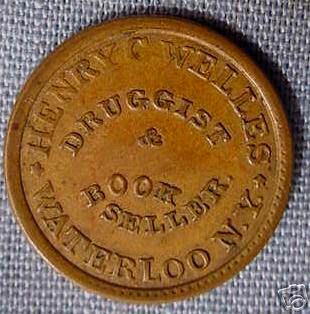
Pictured above is what coin collectors refer to as a store card. It's a token advertising a particular establishment, Mr. Welles in this case around 1861, minted these tokens. Tokens were widely used as small change, usually pennies during the Civil War since there was a shortage of official minted money. This was back when our change actually had intrinsic value, unlike today. So, merchants of all sorts saw an opportunity to spread the word about their particular business. However, the story goes, one saloon keeper in New York City took it too far and minted as many as one million tokens with his name and "Remit for 1 Cent". When the NYC streetcar company tried to remit the hundreds of thousands they'd received for fares, he told them to jump in a lake. They went to Congress, which created stricter laws about private citizens minting US currency.

.


.

Friday, February 8, 2008

Battle Manfully for Southern Rights!!

Someone at Welch & Harris Book Binding had a knack for writing ad copy. Mining old city directories for ads related to the book trades for the American Book Trade Index, I have gone cross-eyed. Twice. I'm currently chasing a Civil War bookseller/ blockade runner/ preacher. In that hunt, I've come across what is to date, my favorite ad copy. Totally unrelated to the other gents I'm tracking, but interesting.

"Authors and Publishers of the South and West, take notice, that we are ready, with our armour on, to battle,MANFULLY, for SOUTHERN RIGHTS, by Binding editions of Books, in muslin, Plain or Gilt, from 1,000 copies, upwards."

By the mid-1850s, people were talking quite a bit of Southern Rights, and using all caps when they spoke of it too.

Manfully bound or no, it seems the business grew. By the beginning of the Civil War, the enterprise became Welch, Harris & Co. According to this 1861 Census, Welch, Harris & Co. was in a wood building at 63 Broad St. in 1861. Too bad no square footages are used to tell us if 63 Broad St. is bigger than 59 Broad St. They are both wood structures. Broad St. is defined as "Runs West from Cooper River to Ashley River, through Wards Nos. 1 and 2."

Tossing my penny searches into the wishing well of Google, I found at ww.bartlebysbooks.com a few pages for sale, so apparently Welch and Harris did some printing as well:

[CONFEDERATE IMPRINT]. Piano Music......
Charleston, SC: Welch, Harris & Co., premium book binders, 1862. Title-page and index leaf only, printed to be used in binding a volume of sheet music. 4to. (4) pp. Title page printed in brown, red, green, and blue, and with a wide triple ornamental border; index leaf printed in blue and black. Not in Parrish & Willingham (cf. P&W 6719 for an 1861 issue of the same title page). Disbound; index leaf with 26 manuscript titles, soiled, a little edgewear, but a good example. (Book ID 50500) $250.00

Also via Google books I found Charles Newcomb Baxter. Confederate Literature: A List of Books and Newspapers, Maps, Music. Boston Athenaeum, 1917. In this digital xerox we find an Almanac for 1864 which mentions another logical sideline for Welch & Harris: book selling.

Miller's Planters' & Merchants' State Rights Almanac for 1864 by AE Miller. Printed, Published and Sold Wholesale & Retail by A.E. Miller, No. 351 King Street. Also sold by Welch & Harris, same place and by Booksellers generally throughout the state.