I like Easter. In Oklahoma, it means Spring is sproinging its onslaught of Tornadoes and wild fires. There's nothing like the smell of cyclonic burning carnage to remind you of renewal. I also like time with family and friends, the Red Cross, the good food, and of course... the vintage ephemera.
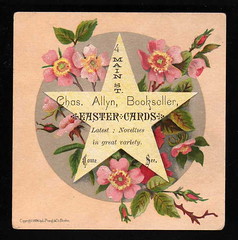
Booksellers were known for selling all kinds of paper goods, including Easter cards, as advertised on this atypical square trade card from the late 1800s. Although he doesn't say where he conducts business beyond Main St., Mr. Allyn published a book, The Battle of Groton Heights in 1882 in New London, CT.
If you're looking for information on an American bookseller, bookbinder or printer, or have any book trade ephemera you want to share with the world, get on over to flickr and post it to the American Book Trade Index.
.

Showing posts with label American Book Trade Index. Show all posts
Showing posts with label American Book Trade Index. Show all posts
Thursday, April 9, 2009


Wednesday, March 4, 2009
Thursday, November 6, 2008
New Seven Roads Flickr Group
.
One of my favorite websites in the bibliosphere is Seven Roads Gallery of Book Trade Labels. It was this website that gave me the idea for the American Book Trade Index. It is a well thought out, attractive, well designed website. Sadly, it has been over a year since it was updated, and emailing Seven Roads webmaster has not yielded a response. Wanting to see more and more book trade labels, I went ahead and started a group on Flickr, under the name Seven Roads Book Trade Labels. The idea of this group is that anyone can post images of book trade labels, and it won't be on just one person to upload these little gems. As always, if you have some to trade or sell, let me know. That's how I became the new owner of these beautiful Dutch gems.
.
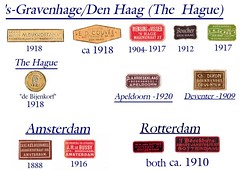
One of my favorite websites in the bibliosphere is Seven Roads Gallery of Book Trade Labels. It was this website that gave me the idea for the American Book Trade Index. It is a well thought out, attractive, well designed website. Sadly, it has been over a year since it was updated, and emailing Seven Roads webmaster has not yielded a response. Wanting to see more and more book trade labels, I went ahead and started a group on Flickr, under the name Seven Roads Book Trade Labels. The idea of this group is that anyone can post images of book trade labels, and it won't be on just one person to upload these little gems. As always, if you have some to trade or sell, let me know. That's how I became the new owner of these beautiful Dutch gems.
.
Tuesday, September 30, 2008
Prodigious Bookstore, Iowa 1858
Seller's Description:
Dubuque, IA" Prodigious" Bookstore Illus Letterhead, 1858
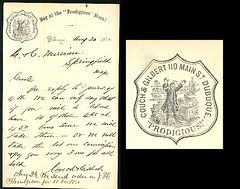
Letter from Couch & Gilbert, proprietors of the "Prodigious" Store, a book store in Dubuque, Iowa. We're not able to interpret the illustration of the man with his arms in the air, but those are books on the shelves. Text is about the wholesale price of dictionaries. Letter sent to G & C Merriam, publishers of Websters. The note at bottom is in the hand of one of the Merriams, either George or Charles. Dated August 20, 1858. Condition: mailing/filing folds. Otherwise VG. 5" X 7 3/4".
Sold for $17.05 25 Sept. 08, not to me.
Advertisement for firm in publication dated 1860 found via GoogleBooks.
.
Dubuque, IA" Prodigious" Bookstore Illus Letterhead, 1858
Letter from Couch & Gilbert, proprietors of the "Prodigious" Store, a book store in Dubuque, Iowa. We're not able to interpret the illustration of the man with his arms in the air, but those are books on the shelves. Text is about the wholesale price of dictionaries. Letter sent to G & C Merriam, publishers of Websters. The note at bottom is in the hand of one of the Merriams, either George or Charles. Dated August 20, 1858. Condition: mailing/filing folds. Otherwise VG. 5" X 7 3/4".
Sold for $17.05 25 Sept. 08, not to me.
Advertisement for firm in publication dated 1860 found via GoogleBooks.
.
Thursday, September 25, 2008
Illustrated bookseller cover book cover
That can be taken so many ways.
June 6, 1898: C.J. Veits, Bookseller, Stationer, News Dealer, Book and Job Printer No. 4 Main St. New London, Conn. Illustrated advertising cover. 4 1/2 by 7 inches
A beautifully illustrated cover, with an illustration of a book with a fine binding and the Bookseller's information on the cover. One of the best advertising covers I've seen in a while, and a design I've not seen before.

June 6, 1898: C.J. Veits, Bookseller, Stationer, News Dealer, Book and Job Printer No. 4 Main St. New London, Conn. Illustrated advertising cover. 4 1/2 by 7 inches
A beautifully illustrated cover, with an illustration of a book with a fine binding and the Bookseller's information on the cover. One of the best advertising covers I've seen in a while, and a design I've not seen before.
Monday, September 15, 2008
Manicule!
.
I love old bookmarks. Suprisingly, I don't see as many as I would suspect issued by Book Stores. I see far more regular trade cards than bookmarks, even though it seems like a similar amount of effort and cost would be involved. Anyway, this is one of the most delightful book marks I've seen in a while and had to share it. Of course, it was spotted on ebay.
Seller's Description:
Size is 2 1/2" long. The back is blank. Wanamaker's was a Philadelphia based store that also had a few satellite stores. One was in Harrisburg which I used to shop in before they closed about 15 or so years ago. Wanamaker's dates to before 1900.
Sold for $61.00, not to me.
.
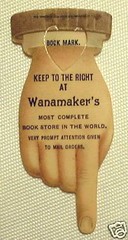
I love old bookmarks. Suprisingly, I don't see as many as I would suspect issued by Book Stores. I see far more regular trade cards than bookmarks, even though it seems like a similar amount of effort and cost would be involved. Anyway, this is one of the most delightful book marks I've seen in a while and had to share it. Of course, it was spotted on ebay.
Seller's Description:
Size is 2 1/2" long. The back is blank. Wanamaker's was a Philadelphia based store that also had a few satellite stores. One was in Harrisburg which I used to shop in before they closed about 15 or so years ago. Wanamaker's dates to before 1900.
Sold for $61.00, not to me.
.
Tuesday, August 26, 2008
AE Foote, Scientific Books in Philadelphia

Visiting with Bibliophiles of Oklahoma member RB, I got the opportunity to look at some of his books. Incredible. Knowing my interest in book trade items, he pointed out a book label that was a little different than the norm. It looked familiar.
 I was fairly certain I had seen it on Seven Roads Book Trade Label Gallery. Not only is it a mouthful, but a tremendous resource for Book Trade historians.
The label was one like the above. "Scientific and Medical Books, and all objects of Natural History. A.E. Foote, M. D. 1223 Belmont Ave., Philadelphia, Pa." I was thinking it looks ca. 1905, but an older company. It maintains the punctuation norms of earlier labels (and signs, and titles, etc.) but with a more "modern" styling, like Pa., instead of Penna. Then I found the Biographical Record of The Mineralogical Record, which answered my questions. Albert E. Foote was a Mineral dealer. Not just a mineral dealer, but THE mineral dealer in the US who also sold books. He even had a mineral display at the 1876 Centennial Expo in Philadelphia, which is very cool to a museum person. My museum hero, George Brown Goode, also happened to be there curating his first exhibit, for the Smithsonian no less. The website also says the AE Foote Co. changed names in 1900. Well there goes my date. At least I have a tentative end date of 1900.

Looking through the 22 mineral specimen labels they've collected from Foote, I found this label dated Feb. 1884. The lower half of it looked awful familiar. Placing the book label next to this specimen label they are nearly identical; probably printed by the same printer. Notice the second numeral 2 in the address is scrunched, the too small period after M in MD.
The entry includes the info that Foote moved out of the Belmont address in 1890. If the specimen label and the book labels were printed at about the same time, we can place this label to mid-1880s to 1890.
So, 1884-1890. That's a date I can live with. This entry will be recorded at the American Book Trade Index for future reference.

My friend and fellow collector is very interested in archeology texts before 1900. Given Foote's specialty, he surely offered many more archaeology books in his time. So, do you have any books with an AE Foote label? Does anyone have a book catalog from Foote? Inquiring minds want to know...
Monday, August 18, 2008
Recent Addition: Mennonite Book Store, postcard interior
.
Scottsdale PA, Mennonite Book Store, postcard interior
Store interior with press back chair in foreground, display cases and counters with books galore. Note the lighting fixtures suspended from the ceiling and, on back wall is an old wood frame wall telephone. Scottdale, Pennsylvania is in Westmoreland County near Mt. Pleasant, Upper Tyrone and Connellsville.
Robbins R-52721 - Circa 1915
Part of my collection.
.
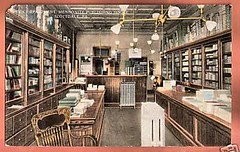
Scottsdale PA, Mennonite Book Store, postcard interior
Store interior with press back chair in foreground, display cases and counters with books galore. Note the lighting fixtures suspended from the ceiling and, on back wall is an old wood frame wall telephone. Scottdale, Pennsylvania is in Westmoreland County near Mt. Pleasant, Upper Tyrone and Connellsville.
Robbins R-52721 - Circa 1915
Part of my collection.
.
Saturday, June 14, 2008
Nebraska to Texas to Massachusetts to Oklahoma....
.
I've seen one of these style labels before, from Wesley Jones of Iowa. It has been digitally captured for the American Book Trade Index and can be found here.
I didn't realize when I saw the Jones piece it was a bookseller label. It was called a small trade card. I let it pass. I was later suspicious it was actually a label and my heart sank a little. You see, book trade labels are probably my favorite type of book trade ephemera. Anyway, although I am from Nebraska originally, I have never seen this label before and was thrilled to find it and add it to my album. For one, it's just purdy.
After a quick googleing, I hit on Ideson Library in Houston Texas. Named for one Julia Bedford Ideson, who just happened to have been born in Hastings, Nebraska. Now, Hastings is one of Nebraska's larger towns, but I doubt many Idesons lived there around the turn of the century, which is about when this label was in use. The one other of these die-cut leaf labels I've seen was ballparked to about 1890-1900. I don't think it's much of a stretch for the daughter of a bookman to become a librarian. Her short bio on HoustonHistory.com filled in some very helpful blanks.

 Julia Bedford Ideson, is largely credited with developing the Houston public library system into the institution it is today. She was born on July 15, 1880, in Hastings, Nebraska, to Rosalie (Beasman) and John Castree Ideson. She attended Hastings public schools until 1891, when her father moved the family to Houston. After graduating from Houston public schools, she entered the University of Texas at Austin as a member of the first class to study library science at that institution.
So, the JC is John Castree and the label would be more appropriately dated to the 1880s-1890s, as the family had left in 1891. I wonder if Mr. Ideson continued to sell books in Houston? His daughter certainly continued a love of books. Even more about this fascinating woman can be found in a nice article in the Handbook of Texas Online.
After a little further investigation, I found a short blurb with a short bio on JC Ideson:
JOHN C. IDESON, of the firm of J. C. Ideson & Co., books, stationery, etc., was born in New York City in 1848, removing with his parents when quite young to Geneva, Ontario Co., N. Y., residing there with them until eighteen years of age. He was then employed as traveling salesman for a nursery for some six years. In 1872, he went to Houston, Tex., where he engaged in the stationery and book business in company with G. W. Baldwin. They carried on business together for five years, after which Mr. Ideson returned to his home in New York State. He came to Nebraska in 1878, and located in Hastings. He purchased 600 acres of land in Hamilton Co., Neb., and was engaged in improving the same until February, 1879, when he engaged in his present business in company with his brother, A. B. Ideson. He confines himself to the management of this business..."
The blurb on AB Ideson does not add any information to the book selling history we glean from JC's article. So, Mr. Ideson was moving to familiar territory when he went to Houston, Texas with a young family. Also, from this we can date the label starting in 1879 and ending in 1891. That's about as good as it gets...
.
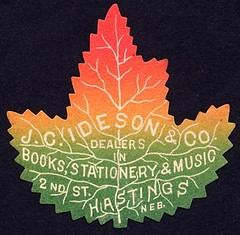
I've seen one of these style labels before, from Wesley Jones of Iowa. It has been digitally captured for the American Book Trade Index and can be found here.
I didn't realize when I saw the Jones piece it was a bookseller label. It was called a small trade card. I let it pass. I was later suspicious it was actually a label and my heart sank a little. You see, book trade labels are probably my favorite type of book trade ephemera. Anyway, although I am from Nebraska originally, I have never seen this label before and was thrilled to find it and add it to my album. For one, it's just purdy.
After a quick googleing, I hit on Ideson Library in Houston Texas. Named for one Julia Bedford Ideson, who just happened to have been born in Hastings, Nebraska. Now, Hastings is one of Nebraska's larger towns, but I doubt many Idesons lived there around the turn of the century, which is about when this label was in use. The one other of these die-cut leaf labels I've seen was ballparked to about 1890-1900. I don't think it's much of a stretch for the daughter of a bookman to become a librarian. Her short bio on HoustonHistory.com filled in some very helpful blanks.
 Julia Bedford Ideson, is largely credited with developing the Houston public library system into the institution it is today. She was born on July 15, 1880, in Hastings, Nebraska, to Rosalie (Beasman) and John Castree Ideson. She attended Hastings public schools until 1891, when her father moved the family to Houston. After graduating from Houston public schools, she entered the University of Texas at Austin as a member of the first class to study library science at that institution.
So, the JC is John Castree and the label would be more appropriately dated to the 1880s-1890s, as the family had left in 1891. I wonder if Mr. Ideson continued to sell books in Houston? His daughter certainly continued a love of books. Even more about this fascinating woman can be found in a nice article in the Handbook of Texas Online.
After a little further investigation, I found a short blurb with a short bio on JC Ideson:
JOHN C. IDESON, of the firm of J. C. Ideson & Co., books, stationery, etc., was born in New York City in 1848, removing with his parents when quite young to Geneva, Ontario Co., N. Y., residing there with them until eighteen years of age. He was then employed as traveling salesman for a nursery for some six years. In 1872, he went to Houston, Tex., where he engaged in the stationery and book business in company with G. W. Baldwin. They carried on business together for five years, after which Mr. Ideson returned to his home in New York State. He came to Nebraska in 1878, and located in Hastings. He purchased 600 acres of land in Hamilton Co., Neb., and was engaged in improving the same until February, 1879, when he engaged in his present business in company with his brother, A. B. Ideson. He confines himself to the management of this business..."
The blurb on AB Ideson does not add any information to the book selling history we glean from JC's article. So, Mr. Ideson was moving to familiar territory when he went to Houston, Texas with a young family. Also, from this we can date the label starting in 1879 and ending in 1891. That's about as good as it gets...
.
Tuesday, May 6, 2008
Selling books in Baltimore
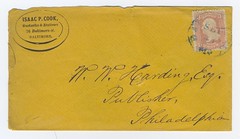
Undated cover, now in digital captivity at the American Book Trade Index.
Isaac P. Cook
Bookseller and Stationer
76 Baltimore St.
All inside a calligraphic swirly. Addressed to WW Harding, Publisher, Philadelphia.
A Baltimore City Directory places Cook at this address (actually W. Baltimore St.) in 1845.
Maryland Historical Society has further info:
COOK FAMILY PAPERS, MS. 2328
Land transactions of Isaac P. Cook (1808-84), Baltimore bookseller and stationer, and his wife, Laura (d. 1876), and daughter, Isabel (fl. 1877-87); correspondence, 1877-80, about property assessment; deeds for Baltimore City and County land, 1808-87.
47 items, 1808-87
Cover posted to ebay here. Sold for under $3. Very little. At that price, I should have grabbed it, but I thought it would go higher. I can always console myself it is out of my collecting area... but I don't feel any better about it...
WW Harding was bankrupt by 1878, according to this article from the NY Times.
.
Friday, April 25, 2008
1881 Detroit, Wilmer Brookes, printing bookstore
.
This wonderful photo hollers to us from about 1881. Brought to my attention by a constant contributor to the American Book Trade Index, Mr. WS. Thanks!! This is one of several from 19th Century Detroit.
If you visit the image on the ABTI you can see it at a larger than life level to see it ain't books out on the table on the walk there. What follows is the info posted on the Detroit Public Library's website, where this info was found.
Antonio Dondero's wicker furniture factory
Three-story brick building, with "A. Dondero" on pediment. Men and boys stand by wicker furniture and baskets on sidewalk. Signs on building read: Detroit Willow Ware Manuf'ry, A. Dondero; photograph gallery; Willmen & Brookes, book & job printers. Brick buildings on both sides. Embossed on photograph front: "B.F.R.B. (?)." Handwritten on mat back: "North side Monroe Ave. bet. Farrer & Randolph, about 1881."
1 photographic print mounted on mat board ; image 8.25 x 6 in.
Reproduction of photograph from the Burton Historical Collection
Courtesy: Detroit Public Library
.
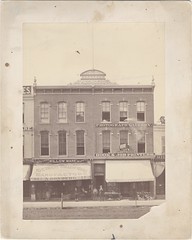
This wonderful photo hollers to us from about 1881. Brought to my attention by a constant contributor to the American Book Trade Index, Mr. WS. Thanks!! This is one of several from 19th Century Detroit.
If you visit the image on the ABTI you can see it at a larger than life level to see it ain't books out on the table on the walk there. What follows is the info posted on the Detroit Public Library's website, where this info was found.
Antonio Dondero's wicker furniture factory
Three-story brick building, with "A. Dondero" on pediment. Men and boys stand by wicker furniture and baskets on sidewalk. Signs on building read: Detroit Willow Ware Manuf'ry, A. Dondero; photograph gallery; Willmen & Brookes, book & job printers. Brick buildings on both sides. Embossed on photograph front: "B.F.R.B. (?)." Handwritten on mat back: "North side Monroe Ave. bet. Farrer & Randolph, about 1881."
1 photographic print mounted on mat board ; image 8.25 x 6 in.
Reproduction of photograph from the Burton Historical Collection
Courtesy: Detroit Public Library
.
Monday, April 14, 2008
1873, Webster's Dictionary ad


.
On this day April 14th, 1828 Noah Webster published the first edition of his dictionary. Webster at the age of 70, Webster published his American Dictionary of the English Language in two quarto volumes (with pages 19 cm (7 in.) wide[1] and roughly 25cm (10in.) tall) containing 70,000 entries. According to Wikipedia he did. I honestly don't know a lot about Webster's dictionary. I have enjoyed accounts of Samuel Johnson's dictionary, and Simon Winchester's The Meaning of Everything, the story of the OED. I've included another image from the American Book Trade Index, this time an ad for Webster's dictionary from an 1873 New Hampshire Farmer's Almanac. The dictionary was offered for $12!

.
Tuesday, April 8, 2008
Book Shop Cats
.
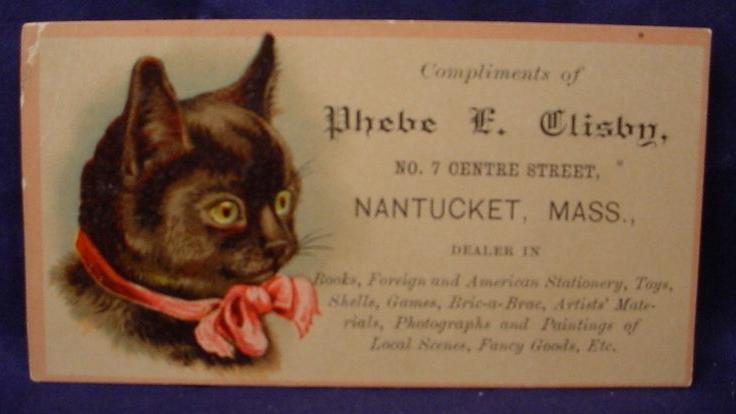 Why do all used book stores have cats? Don't tell me any reasons that explain how wonderful cats are. No. Cats are... well, they're a lot of things, but one thing for certain: they are not for me. People don't own cats, cats retain you for their staff.
I think at least half of all used book stores have cats. Stores without feline tenants are over compensated for as it is rare to find a catty bookstore without several creatures within. So, my conservative estimate is that there are at least 3 bookselling cats for every used and antiquarian book shop in North America. If you think you can escape cats in books about bookshops, well the ratio in fiction is at least 12:1! Now, this is all based on years of extensive research and a dislike of cats.
Before the bibliocommunity starts heating up the tar and plucking chickens, I offer these: 19th century trade cards featuring cats. These cats aren't too bad. They're mostly cute, they don't shed, don't make a racket or *ahem* mark territory.
Since nearly all of my readers (well, both of you) are "cat people" I post the following for your viewing pleasure. Of course, these are only a few contributions to the American Book Trade Index, which churns on. We are currently closing in on the 1800 image mark! Hooray!
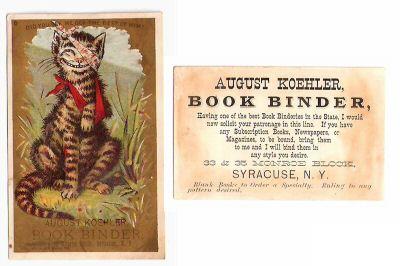
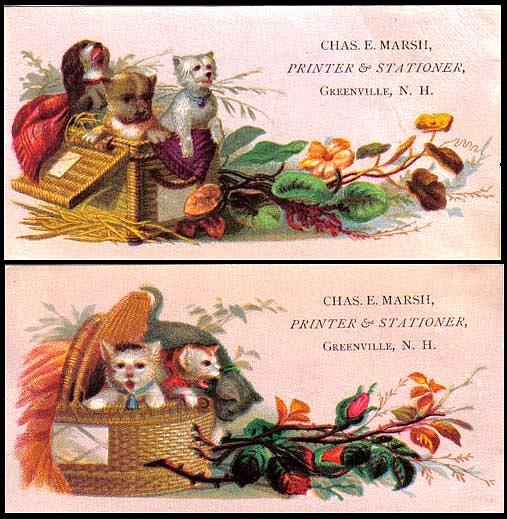
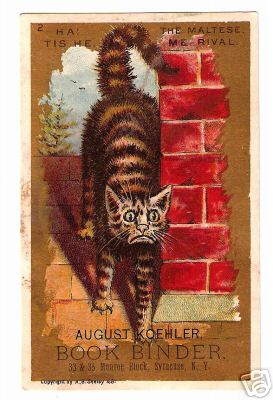
Why do all used book stores have cats? Don't tell me any reasons that explain how wonderful cats are. No. Cats are... well, they're a lot of things, but one thing for certain: they are not for me. People don't own cats, cats retain you for their staff.I think at least half of all used book stores have cats. Stores without feline tenants are over compensated for as it is rare to find a catty bookstore without several creatures within. So, my conservative estimate is that there are at least 3 bookselling cats for every used and antiquarian book shop in North America. If you think you can escape cats in books about bookshops, well the ratio in fiction is at least 12:1! Now, this is all based on years of extensive research and a dislike of cats.
Before the bibliocommunity starts heating up the tar and plucking chickens, I offer these: 19th century trade cards featuring cats. These cats aren't too bad. They're mostly cute, they don't shed, don't make a racket or *ahem* mark territory.
Since nearly all of my readers (well, both of you) are "cat people" I post the following for your viewing pleasure. Of course, these are only a few contributions to the American Book Trade Index, which churns on. We are currently closing in on the 1800 image mark! Hooray!
Friday, January 25, 2008
Suffragette on a Flying Trapeze

My personal collection of book trade ephemera is *supposed* to focus on the book trades of the frontier. I have to remind myself of that every once in a while. Am I the only one who gets sucked down tangents? I doubt it.
Anyway, I've had a business card for a while for one FR Aldrich, an agent for Advance Steam Printing Co. in Norman, Oklahoma Territory. Now, Norman was founded and occupied the night of the initial land run into the Unassigned Lands April 22, 1889. Oklahoma became a state in November 1907. That date range was the closest I could get to FR Aldrich and his business. An 18 year gap is a little too big for me for someone really not all that long ago or far away.
I tried Googling the name F.R. Aldrich, thinking Aldrich would be an uncommon enough name to locate easily. I did find lots of Fr. Aldriches, as in Father Aldrich, and I did find a couple FR Aldriches. One was a female college student in the 1940s on the east coast, others had too little info for a positive ID. But one suspect turned up in Kansas in 1913 and 1916 and was a school district superintendent. He (?) could be the same person. Not much difference in time and location, but a little bit of a career shift. Then again, we've already uncovered more than one barber bookseller. I could see how connections to publishing and printing could be useful as a school superintendent.
I turned my attention to identifying the font used for the main text. I had hoped the font would help me date the card. Printers like to use new hip typefaces in their advertisements, an opportunity to show off new faces and technical capabilities. If I can get the actual name of the face, maybe I can track down a date and get closer to figuring out FR Aldrich's story. Today, thanks to the charter member from Michigan of the American Book Trade Index, I found another example of this cool, but odd font in a directory ad for a newspaper in Ann Arbor Michigan from 1892.

The 1892 date of the directory is spot on for the range I already had. I've run through the resources of the Oklahoma Historical Society for FR Aldrich and the Advance Steam Printing Co. without any luck. I ran the FR Aldrich card through What the Font , a website you can upload .jpg files and the website searches out the closest match for your font. The first time I ran the card through none of the "matches" were even close. Admittedly, the image of the card isn't very sharp, and there just aren't that many letters to work with, especially letters that would be totally unique to this type face. I ran the Ann Arbor Democrat ad through, and What The Font matched it very closely to a face called Trapeze Normal. Very cool. Almost.
The problem is that there are other computer fonts called Trapeze, and I can't seem to find the historic typeface's name it is based on. It's a lead and perhaps one more piece of the puzzle. Maybe just a piece of a piece.
But, Emma E. Bower caught my eye. Now, it really was not uncommon for women to be editor/ publishers of newspapers in the U.S. In fact, women had been in charge of presses from the very earliest presses in North America in 1639. However, in many cases, these women were widows taking full control over the family printing business. They would often operate under their husband's name, or under initials.
Googling Ms. Bower reveals some tempting tangents. First of all, she is Dr. Emma E. Bower, M.D., of Port Huron, St. Clair County, Michigan. Not only a Democrat, but a Delegate to Democratic National Convention from Michigan, in 1920. She served as Secretary of the Ladies of the Maccabees, an insurance/ fraternal organization for women only, from 1893 until at least 1919. The Knights of the Maccabees claim them as an auxiliary organization at least well into the 1920s. The Ladies of the Maccabees said they started out as such, but had become "wholly independent" after a couple short years. Her name also appears with some mentions of the suffrage and temperance movements, but I couldn't find any specifics or print sources I could access for more info. She certainly sounds interesting!
So, from the Land Run in Oklahoma to a suffragette in Michigan. Stupid tangents...
Friday, January 11, 2008
AA and Ephemera Collecting

A recent arrival for my collection. Typically I buy items and put them away once a decent image is uploaded to the American Book Trade Index. Then I'll go back and poke around, recording details as I can find in bibliographies and Google. Blah, blah, blah, but it is a lot of fun, and odd things turn up. This advertising cover is a great example.
Some details: 1875 is in the round part along the roof line of the building. What's that round bit of wall that sticks up called anyway? The sign at the top of the building says "Rialto Block". A sign below the top row of windows reads "Journal Bindery". The address under the engraving says "State St., Montpelier, Vt.". I looked a bit for a Clarks Journal in Montpelier, and didn't find much. A JD Clark is listed as a bookbinder on the Rialto Block in an 1887-8 Directory. So, according to the cancellation mark on the cover, and the directory, we can place Clark-Journal Bindery at least from 1883-1888.
I thought I would try looking for the addressee, a Judge Walter P. Smith. Well, it turns out he's the father of Robert Holbrook Smith. Robert H. Smith is generally known as Dr. Bob, one of the founders of Alcoholics Anonymous. The enclosure from the envelope is long gone. I imagine it would have been a bill or a quote for binding ledgers or some such thing. The Clarks Journal sounds like a bindery attached to a newspaper. These kinds of operations did a lot of ledger and similar binding.
So, does the Rialto Block on State Street still stand in Montpelier?
Thursday, January 10, 2008
1908 Chicago Fire
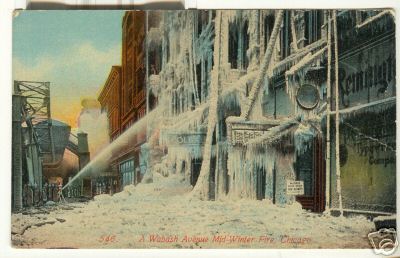

Digging a little more, I found the photograph on which the postcard is based. Walter Carl Schneider took this photo, I assume, on the morning of the 28th. By 1908 the 24-year old amateur photographer had seen his work published in The New York Herald. I couldn't find any information about Mr. Schneider selling this photo to be made into a postcard, but it apparently was.
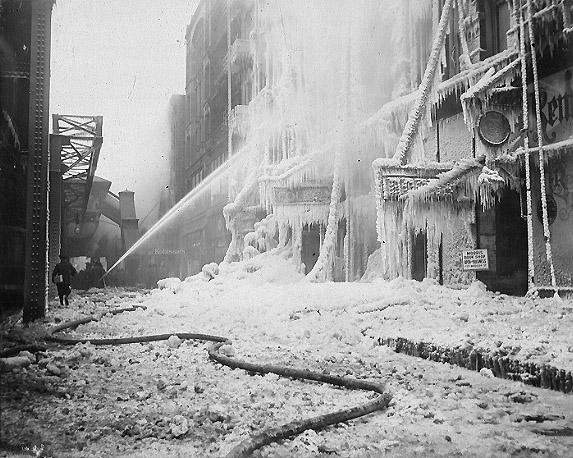 The fire on Wabash Ave. didn't seem to keep the Morris Book Shop down though. Catalog 77 from the Morris Book Shop is offered via the ABAA website featuring 46 pages of "Books and Literary Material". No address given online, but it is dated 1917.
Sunday, December 30, 2007
Lion of New Hampshire spotted
 2007 is drawing to a close. Folks are setting goals, evaluating old ones. For instance, a couple months ago I decided to go ahead and write a little on bookseller ephemera, my own book collecting, and getting a collector club started. I really shouldn't let the blog drift into a being all about "Stuff I couldn't afford on eBay". After all who wants to read about that? And look at this monster: Who would call that ephemera? I don't have absolute answers here, but I am the only one shouting into the darkness at this webress, so I get to do as I please. That, and I just had to share this wonderful object, even though it is not en route to my house. I tried. It looks to be a cast brass embossing stamp (embosser?) for EJ Copp & Company of Nashua, New Hampshire. I wonder if they used it on stationery, invoices and receipts, or if some of these embossed stamps made it into books. For shame! After some light digging at Google, a couple details about this man emerge. Like many men of his generation, EJ Copp was a veteran of the Civil War.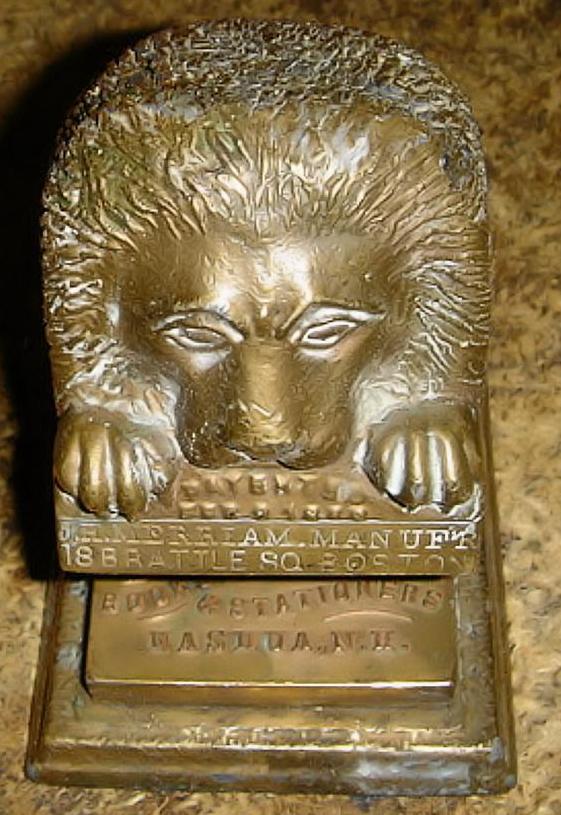
According to John H. Goodale, author of History of Hillsborough County, New Hampshire (Philadelphia: JW Lewis & Co., 1885) page 182, "In the battle of Drury's Bluff, May 13, 1864, while making an advance on Richmond, this regiment bore the "brunt" of the contest. Major James F. Randlett, now captain of a cavalry company in the regular army, was wounded. Adjutant Elbridge J. Copp, who, entering the service as a private at seventeen, had won promotion, was also wounded. On the 16th of August a fierce engagement took place at Deep Bottom, at which Adjutant E.J. Copp was severely wounded, which compelled him, in October following, to return to Nashua." An obit from 1887, for his father gives us a shade more info about his war service and the years after "Mr. Joseph Copp, a prominent citizen of Nashua, NH, died recently at 86. He left a married daughter and five sons, among the latter being Rev. H.B. Copp, Capt. C.D. Copp and Col. E.J. Copp, the last-named in command of the Second Regiment of the State National Guard."
I'm going to assume that Mr. Copp was not yet in business at the outbreak of the war, being 17 years old. However, it doesn't seem like he waited long after the war. An insurance report from a fire in Nashua in April 1870 records a slight loss at "C. D. & E. J. Copp, books, etc."
 Well our stamp doesn't mention a CD Copp, so I have to track him down. Searching for a CD Copp from Nashua in the latter 1800s reveals one Capt. Charles Dearborne Copp. He turns out to be a Medal of Honor Winner. According to the internet, he was born April 12, 1840, entered the US Army from Nashua NH. He earned the Medal of Honor during the Battle of Fredricksburg December 13, 1862. "In action against Confederate forces, Second Lt. Charles Copp seized the regimental colors after the color bearer had been shot down, and waving them, rallied the regiment under heavy fire."
Being in the book business, Elbridge Copp's own contribution came to light in 1911. One bookseller describes Reminiscences of the War of the Rebellion 1861-1865. "Copp claimed to be the youngest commissioned officer in the Union Army during the war. This Scarce reminiscence of the 3rd NH volunteers is nicely done with numerous maps, illustrations and photos of members of the Regiment." One offering also includes this information "Long inscription by the author's widow: "Colonel Copp fought his last great battle, with his usual bravery and fortitude, in the summer of 1923, responding to the "roll call" on high on August 3rd, taps were sounded on August 6th." So, if we presume he was 17 in 1861, he would have been about 79 in 1923.

Friday, October 12, 2007
WPA October Library Poster

I love the month of October! The changing leaves, the cooler weather. How do we spell relief in Oklahoma? O-C-T-O-B-E-R. I grew up in Nebraska. There, it was typically Octo-brr-rrrrr. Confession: another big plus for me is College Football. I digress.
October seems to be a bookish month. Am I the only one who feels this way? I don't know if it's because school is in full swing, if the cooler weather slows us down, but it seems like more people read now than in the summer. Autumn makes me think of reading and libraries. I ran across some great WPA artists and thier posters somewhere on the internet. This little gem is probably my favorite. Does anyone know what "Bright Blue Weather" means? I have no idea, but this poster is just fantastic. I have some other very nice scans of WPA library related posters and will post them in the appropriate months. Pinky swear. Proof? Look below for one for September.
In other news, we at the American Book Trade Index group at Flickr, are now up and over 1000 images! Hooray! Also, please note: I said "we". That's right, there is now membership. Of course, I belong (who wouldn't?), but more importantly, a gentleman with interests in the history of Michigan has come aboard.
So, let me extend the invitation again: Enjoy this most-bookish month and get in on the ground floor of what could be an amazing tool for researching the history of the book in America: The American Book Trade Index.
Subscribe to:
Posts (Atom)