.
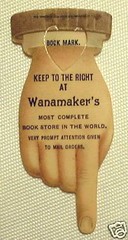
I love old bookmarks. Suprisingly, I don't see as many as I would suspect issued by Book Stores. I see far more regular trade cards than bookmarks, even though it seems like a similar amount of effort and cost would be involved. Anyway, this is one of the most delightful book marks I've seen in a while and had to share it. Of course, it was spotted on ebay.
Seller's Description:
Size is 2 1/2" long. The back is blank. Wanamaker's was a Philadelphia based store that also had a few satellite stores. One was in Harrisburg which I used to shop in before they closed about 15 or so years ago. Wanamaker's dates to before 1900.
Sold for $61.00, not to me.
.

Monday, September 15, 2008


Friday, September 12, 2008
Fame!
 .
.I was regretting a late supper at IHOP, out of town with work and feeling a little low. You know what I mean? It isn't fun staying in a strange town and not feeling well. I remembered I left my phone on the charger while at supper and noticed I had a new message. That is when fame found me, in the Marriott Courtyard in Santa Fe. My friend and fellow bibliophile Dr. RB called to congratulate me on my new found fame and appearing in print. Apparently the Exile Bibliophile blog is mentioned in the current issue of Rare Book Review! I had no idea, but couldn't be more pleased. Well, maybe if they sent me a subscription...
Confession: I read every new issue of this magazine cover-to-cover, but very rarely buy it. Published in the UK and flown to the US in Dom Perignon powered golden airplanes, this is a pricey magazine at $78 per annum for 6 issues. Don't misunderstand me, this is a fabulous magazine, but I can't afford it. So, when you're sitting in Barnes and Noble, drinking the free water and leaving sweaty, smudgy fingerprints all over Rare Book Review, you're not alone. I do it too.
Tuesday, September 2, 2008
Bibliophile on BookTV


C-Span has a series on C-Span2 on the weekends called BookTV. BookTV typically leans heavy on politics and "current events", which I usually find distasteful or dull. Not so this weekend! However, if you remember from way back to June, you may recall Kevin Hayes's new book The Road to Monticello came out this summer and he was invited to share some thoughts on Book TV. The episode filmed in June finally aired this weekend. If you missed it, this link should take you there. What is nice, is you can w
 atch the entire talk (45 mins.) on the website. Very cool, and congrats to Kevin!
Tuesday, August 26, 2008
AE Foote, Scientific Books in Philadelphia

Visiting with Bibliophiles of Oklahoma member RB, I got the opportunity to look at some of his books. Incredible. Knowing my interest in book trade items, he pointed out a book label that was a little different than the norm. It looked familiar.
 I was fairly certain I had seen it on Seven Roads Book Trade Label Gallery. Not only is it a mouthful, but a tremendous resource for Book Trade historians.
The label was one like the above. "Scientific and Medical Books, and all objects of Natural History. A.E. Foote, M. D. 1223 Belmont Ave., Philadelphia, Pa." I was thinking it looks ca. 1905, but an older company. It maintains the punctuation norms of earlier labels (and signs, and titles, etc.) but with a more "modern" styling, like Pa., instead of Penna. Then I found the Biographical Record of The Mineralogical Record, which answered my questions. Albert E. Foote was a Mineral dealer. Not just a mineral dealer, but THE mineral dealer in the US who also sold books. He even had a mineral display at the 1876 Centennial Expo in Philadelphia, which is very cool to a museum person. My museum hero, George Brown Goode, also happened to be there curating his first exhibit, for the Smithsonian no less. The website also says the AE Foote Co. changed names in 1900. Well there goes my date. At least I have a tentative end date of 1900.

Looking through the 22 mineral specimen labels they've collected from Foote, I found this label dated Feb. 1884. The lower half of it looked awful familiar. Placing the book label next to this specimen label they are nearly identical; probably printed by the same printer. Notice the second numeral 2 in the address is scrunched, the too small period after M in MD.
The entry includes the info that Foote moved out of the Belmont address in 1890. If the specimen label and the book labels were printed at about the same time, we can place this label to mid-1880s to 1890.
So, 1884-1890. That's a date I can live with. This entry will be recorded at the American Book Trade Index for future reference.

My friend and fellow collector is very interested in archeology texts before 1900. Given Foote's specialty, he surely offered many more archaeology books in his time. So, do you have any books with an AE Foote label? Does anyone have a book catalog from Foote? Inquiring minds want to know...
Wednesday, August 20, 2008
Fraud / Approved Forgeries / Misunderstanding

Nearly every blog in the bibliosphere has posted on the Craig's List ad for forgers. To sum, the ad is seeking folks to: "ghost sign copies of a newly released book on behalf of the authors. You will need to be able to copy the look and style of both author's signatures." No one has been able to get a hold of the firm advertising for these "ghost signers".... until now.
I just got a very tired young lady on the phone and asked about the position. She said, "It was a mistake. A big misunderstanding. That project is not going forward." She said the ad was, or should be, taken down already. I asked which authors it was for, and she said she was not privileged to give out that information. I asked which publisher and got the same answer only more curt.

Monday, August 18, 2008
Recent Addition: Mennonite Book Store, postcard interior
.
Scottsdale PA, Mennonite Book Store, postcard interior
Store interior with press back chair in foreground, display cases and counters with books galore. Note the lighting fixtures suspended from the ceiling and, on back wall is an old wood frame wall telephone. Scottdale, Pennsylvania is in Westmoreland County near Mt. Pleasant, Upper Tyrone and Connellsville.
Robbins R-52721 - Circa 1915
Part of my collection.
.
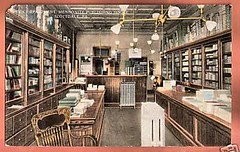
Scottsdale PA, Mennonite Book Store, postcard interior
Store interior with press back chair in foreground, display cases and counters with books galore. Note the lighting fixtures suspended from the ceiling and, on back wall is an old wood frame wall telephone. Scottdale, Pennsylvania is in Westmoreland County near Mt. Pleasant, Upper Tyrone and Connellsville.
Robbins R-52721 - Circa 1915
Part of my collection.
.
Saturday, August 9, 2008
Weil - Ptak Ephemera Scale

Marty Weil of the The Ephemera Blog and John Ptak of The Science Bookstore have put together a useful rubric for measuring "ephemeralness". Marty says
"WP Ephemera Scale standardizes the relative indicators of what makes something ephemera into six principal categories and grades them on a scale of 5 through 30, least ephemeral to most. The indicators approximate the printed item's importance, distribution, susceptibility for being saved, durability, age, and purpose."
They then break down 5 categories, and assign a score (1-5) to the various attributes. So, 5 would be the lowest total score possible, and would be the most ephemeral item. A 30 would be the highest, least ephemeral thing. These include:
(A) Place of origin/population target. (Approximation of how many of these printed items were made.) What sort of population was it printed for? (5) town (4) region (3) city (2) state (1) countryOne thing that could be very difficult to measure is (A) the quantity of an item printed. The target audience is a good, but rough guide. I can't think of anything as effective, certainly nothing more effective. I don't like that the evaluator needs to draw conjectures and extrapolate, but I think this may be as good as it gets.
(B) Amount of usage/intended amount of use of the printed item. (5) Single, one-time usage (implying it was collected after use/thrown away) (4) multiple (3) monthly (2) yearly (1) lifetime(B) also perhaps needs more definition. For instance, how do I score something that was not expected to last very long, but expected to be used up over a few months? Is that multiple or monthly? Or is something "monthly" if I use it once a month?
(C) Purpose of the printed item. (5) Very highly restricted (1) very widely employed, multi-purpose
I think we need some things defined. Like (C), what is "highly restricted" intended use vs. multi-purpose? Like a matchbook- usually limited to the life of 20 matches (on a windy night, that could be very short), or is it multi-purpose? Are there degrees in the middle?
(D) Savability--reasons why the item might have been saved. (5) Very low (reason to save it, like an unused bus transfer, laundry ticket; OR, the item was collected after use; (4) Low (intended for a single use but was not necessarily collected once used (like a movie stub); (3) Medium (2) High (1) very high reason to save (like wedding photos, military troop photos, baby pictures, that sort)
(E) Medium (the physical object itself and the stuff it is made of, meaning that if it was flimsy, toilet-paper-like material it would just not stand the test of time better than, say, a vellum document. It was made to be dispensable.) (5) Flimsy, potentially volatile material; (4) newsprint (3) cheap paper but better than newsprint (2) strong, good book-paper (1) very strong (vellum, thick, cover-stock paper
(F) Age. (5) New (4) Newish to 5 years old (3) 6-25 years old (2) 26-100 years old (1) 200+ years old
I believe (F) is supposed to score the other direction, but you get the idea. So, I want to put the WP Scale to test and see what there is to see.
This scale is really wonderful and it is certainly evident a lot of thought and consideration has gone into it. I think it will be a helpful tool, especially to people who do not deal much with ephemera, to understand what makes a piece special. It could also be very helpful to collection managers and archivists to help quantify the scarcity of ephemera in museum and library/archive collections. Another thing I like, is that to use the scale, you have to have the object in your hands. This cannot be done by photos, or arbitrarily they way many booksellers grade their books.
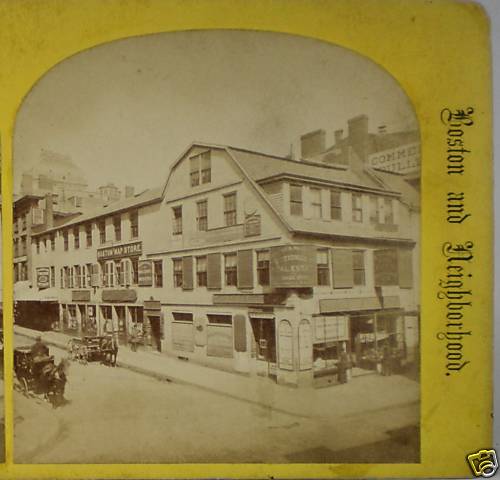
OK, so let's apply the scale to a stereoview I just bought this last week or two. It is an image of the Old Corner Bookstore in Boston.
A) I've seen this stereoview a few times before, and know this was an oft-printed series. I would rate it a 3. I think 3 is too high, perhaps 2 should be for states and large cities. Afterall, the population of Boston in the 1870s was bigger than some of the more rural states.
B) Amount of usage. I think a 2, yearly. I don't think stereoview publishers thought these would last a lifetime, but were intended to last a long time.
C) 1. Stereoviews were meant to be used many, many times in the home, or at a reading room, school, etc.
D) 2 for savability.
E) 1 for medium. Stereoviews were often printed on very heavy cardstock, but quality varies. My example is on one of the nicer stocks.
F) 4. The stereoview has a handwritten date on the back of Nov. 1872, in period brown dip-pen ink. It was black ink, but it turned a very dark brown after 130+ years of oxidation. The date also fits the style of stereoview.
So, the WP Ephemera Score for my stereoview would be: 13. For this particular stereoview, I think this is a good score and reflects the ephemerality of this item. I've told you before, I'm not above making up words.
Saturday, August 2, 2008
Bookmobile Toy at Auction


I had a slew of the old steel Tonka trucks my Dad grew up playing with. There was a firetruck, a pickup with a horse trailer, a big yellow dump truck I could put my knee in and push myself around scooter-style. I loved these trucks for the fact they were made of steel, like a real truck. They had hard rubber tires unlike my other toy trucks that had soft tires and plastic bodies.
So, another bookmobile grabbed my attention this week. This time it is on ebay, and it is in perfect original condition. The seller pegs it as 1950s and it is likely Japanese in origin. Seller had to add the word "bookmobile" to the listing, as the toy was marketed as "Children's Book Service Car." This thing is just beautiful, and is currently sitting at $350.00! It may sound like a lot, but try to find another one. The seller describes the toy:
"The library on wheels was a fairly common sight in the North American suburbs of the 1950s and one that is captured nicely in this 11.5 inch toy by some obscure Japanese toy maker (signed with the trademark "AN"). The truck comes with a working friction motor and measures 11.5 inches in total. It is in mint condition and comes with its beautifully illustrated original box. It is the only example of this toy that I have seen to date."
There are several things I really like about this toy. The first is the colors. I also find the awkward English phrases charming. "Lets Read the Good Books!" and "Children's Book Service Car." I also like the fake book covers painted on the side and that the books look as though they open left-to-right and some open right-to-left. Two things I don't like. The biggest thing (to me) is that you'd need some freakin' huge kids to be able to reach those books! Maybe if I made a little matching rolling ladder to go with it. The other is the extremely constipated expression on the children's faces on the protective doors. They do not look eager to read the good books. It looks like the back door swings down, but the seller didn't clue us in for sure. Otherwise, these are tantalizing images. Perhaps all the more as we can't see inside.
I casually looked around the internet this week for other bookmobile toys. There don't seem to be very many. Have you seen any? Did you have one as a kid? Do you have it still? Will you send it to me?


Wednesday, July 23, 2008
Bookbinding cats postcard
.
One of the most popular posts to date (gah!) has been bookshop cats. I don't care much for them, but it seems most other book people rather like them. By the way, I believe the artist intended that to be an inkwell set close by the feather quill, and not a poo. Although, that lazy cat is looking a bit smug and like he's gotten away with something.
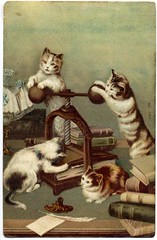
One of the most popular posts to date (gah!) has been bookshop cats. I don't care much for them, but it seems most other book people rather like them. By the way, I believe the artist intended that to be an inkwell set close by the feather quill, and not a poo. Although, that lazy cat is looking a bit smug and like he's gotten away with something.
Monday, July 21, 2008
Ex Libris Mobilis
.

 I've recently run into Tom online. Tom is the lucky owner of a 1955 Chevy bookmobile named Baby. Can I even begin to say how jealous I am? Very cool. He is planning to hit the national car show circuit with it next year, with a compliment of pre-1955 books.
If you're curious if he has a copy of Here Comes the Bookmobile by Dirk Gringuis, published in 1952, yes he does. From what I understand, it is the first bookmobile book written for kids. Anyone know of one earlier?
According to Tom: "In the Spring of 1955, the Anderson, South Carolina Library ordered a Second-Series Chevy 3600 Chassis-Cab, and sent the unit off to Rock Hill, SC to have the book box built. The Rock Hill Body Company (RHBC) created the box, an evolutionary design with walk-in center core and exterior
I've recently run into Tom online. Tom is the lucky owner of a 1955 Chevy bookmobile named Baby. Can I even begin to say how jealous I am? Very cool. He is planning to hit the national car show circuit with it next year, with a compliment of pre-1955 books.
If you're curious if he has a copy of Here Comes the Bookmobile by Dirk Gringuis, published in 1952, yes he does. From what I understand, it is the first bookmobile book written for kids. Anyone know of one earlier?
According to Tom: "In the Spring of 1955, the Anderson, South Carolina Library ordered a Second-Series Chevy 3600 Chassis-Cab, and sent the unit off to Rock Hill, SC to have the book box built. The Rock Hill Body Company (RHBC) created the box, an evolutionary design with walk-in center core and exterior fold-out wing doors. In '58, the Anderson County Library System was created by referendum, and the Bookmobile continued in service till 1991."
I asked if he planned on using a bookplate for the collection and he did not know what a bookplate was. I directed him to Confessions of a
fold-out wing doors. In '58, the Anderson County Library System was created by referendum, and the Bookmobile continued in service till 1991."
I asked if he planned on using a bookplate for the collection and he did not know what a bookplate was. I directed him to Confessions of a Bookplate Junkie. If you are not familiar with Confessions, it is my favorite ex libris blog. I was also curious if anyone out there have ever seen a bookplate, specific to bookmobiles, or featuring bookmobiles. I've certainly never seen one. I asked Mr. Junkie, of the above plugged blog, and it turns out that he hasn't either. Perhaps they'd be more appropriately called ex libris mobilis.
Thinking about it, if a bookplate featured a bookmobile, it would be from a collection of books that stayed with the bookmobile, and did not generally circulate among a library system. It seems that many (most?) libraries stock bookmobiles with books from the general circulating collections, so a bookmobile specific bookplate seems unlikely. Perhaps a mobile branch librarian could help us out?
The four photos of Baby the Bookmobile are inside and out "As Found", and inside and out, "Cleaned up". She's in an amazing state of preservation. I can't wait to see her on the road!
.
Bookplate Junkie. If you are not familiar with Confessions, it is my favorite ex libris blog. I was also curious if anyone out there have ever seen a bookplate, specific to bookmobiles, or featuring bookmobiles. I've certainly never seen one. I asked Mr. Junkie, of the above plugged blog, and it turns out that he hasn't either. Perhaps they'd be more appropriately called ex libris mobilis.
Thinking about it, if a bookplate featured a bookmobile, it would be from a collection of books that stayed with the bookmobile, and did not generally circulate among a library system. It seems that many (most?) libraries stock bookmobiles with books from the general circulating collections, so a bookmobile specific bookplate seems unlikely. Perhaps a mobile branch librarian could help us out?
The four photos of Baby the Bookmobile are inside and out "As Found", and inside and out, "Cleaned up". She's in an amazing state of preservation. I can't wait to see her on the road!
.

 I've recently run into Tom online. Tom is the lucky owner of a 1955 Chevy bookmobile named Baby. Can I even begin to say how jealous I am? Very cool. He is planning to hit the national car show circuit with it next year, with a compliment of pre-1955 books.
If you're curious if he has a copy of Here Comes the Bookmobile by Dirk Gringuis, published in 1952, yes he does. From what I understand, it is the first bookmobile book written for kids. Anyone know of one earlier?
According to Tom: "In the Spring of 1955, the Anderson, South Carolina Library ordered a Second-Series Chevy 3600 Chassis-Cab, and sent the unit off to Rock Hill, SC to have the book box built. The Rock Hill Body Company (RHBC) created the box, an evolutionary design with walk-in center core and exterior
I've recently run into Tom online. Tom is the lucky owner of a 1955 Chevy bookmobile named Baby. Can I even begin to say how jealous I am? Very cool. He is planning to hit the national car show circuit with it next year, with a compliment of pre-1955 books.
If you're curious if he has a copy of Here Comes the Bookmobile by Dirk Gringuis, published in 1952, yes he does. From what I understand, it is the first bookmobile book written for kids. Anyone know of one earlier?
According to Tom: "In the Spring of 1955, the Anderson, South Carolina Library ordered a Second-Series Chevy 3600 Chassis-Cab, and sent the unit off to Rock Hill, SC to have the book box built. The Rock Hill Body Company (RHBC) created the box, an evolutionary design with walk-in center core and exterior fold-out wing doors. In '58, the Anderson County Library System was created by referendum, and the Bookmobile continued in service till 1991."
I asked if he planned on using a bookplate for the collection and he did not know what a bookplate was. I directed him to Confessions of a
fold-out wing doors. In '58, the Anderson County Library System was created by referendum, and the Bookmobile continued in service till 1991."
I asked if he planned on using a bookplate for the collection and he did not know what a bookplate was. I directed him to Confessions of a Bookplate Junkie. If you are not familiar with Confessions, it is my favorite ex libris blog. I was also curious if anyone out there have ever seen a bookplate, specific to bookmobiles, or featuring bookmobiles. I've certainly never seen one. I asked Mr. Junkie, of the above plugged blog, and it turns out that he hasn't either. Perhaps they'd be more appropriately called ex libris mobilis.
Thinking about it, if a bookplate featured a bookmobile, it would be from a collection of books that stayed with the bookmobile, and did not generally circulate among a library system. It seems that many (most?) libraries stock bookmobiles with books from the general circulating collections, so a bookmobile specific bookplate seems unlikely. Perhaps a mobile branch librarian could help us out?
The four photos of Baby the Bookmobile are inside and out "As Found", and inside and out, "Cleaned up". She's in an amazing state of preservation. I can't wait to see her on the road!
.
Bookplate Junkie. If you are not familiar with Confessions, it is my favorite ex libris blog. I was also curious if anyone out there have ever seen a bookplate, specific to bookmobiles, or featuring bookmobiles. I've certainly never seen one. I asked Mr. Junkie, of the above plugged blog, and it turns out that he hasn't either. Perhaps they'd be more appropriately called ex libris mobilis.
Thinking about it, if a bookplate featured a bookmobile, it would be from a collection of books that stayed with the bookmobile, and did not generally circulate among a library system. It seems that many (most?) libraries stock bookmobiles with books from the general circulating collections, so a bookmobile specific bookplate seems unlikely. Perhaps a mobile branch librarian could help us out?
The four photos of Baby the Bookmobile are inside and out "As Found", and inside and out, "Cleaned up". She's in an amazing state of preservation. I can't wait to see her on the road!
.
Thursday, July 17, 2008
Bibliophile on Book TV!
.
C-SPAN to Film Author Kevin Hayes and 'The Road to Monticello' at Full Circle on Friday, July 18 at 6:30 p.m.
 Join us this Friday for a special event featuring Kevin J. Hayes, Professor of English at University of Central Oklahoma and author of The Road to Monticello: The Life and Mind of Thomas Jefferson, a biography of Thomas Jefferson as an intellectual. C-SPAN will be on site to film Hayes' talk about his new book.
In The Road to Monticello, Hayes, looking at Jefferson's correspondence, literary efforts, and libraries, follows Jefferson's education from a young man to lawyer; from his original estate which burned down to his time in Europe, his time in office, and finally to his retirement at Monticello. Jefferson, mythic American figure and third President of the United States, was an able statesman and politician, as well as a philosopher, a scholar, and a gentleman.
Publisher's Weekly says of the book: "Hayes… takes us through Jefferson's hugely wide and eclectic reading with an ease and lightness often missing from a subject central to American history"
.
C-SPAN to Film Author Kevin Hayes and 'The Road to Monticello' at Full Circle on Friday, July 18 at 6:30 p.m.
Join us this Friday for a special event featuring Kevin J. Hayes, Professor of English at University of Central Oklahoma and author of The Road to Monticello: The Life and Mind of Thomas Jefferson, a biography of Thomas Jefferson as an intellectual. C-SPAN will be on site to film Hayes' talk about his new book. In The Road to Monticello, Hayes, looking at Jefferson's correspondence, literary efforts, and libraries, follows Jefferson's education from a young man to lawyer; from his original estate which burned down to his time in Europe, his time in office, and finally to his retirement at Monticello. Jefferson, mythic American figure and third President of the United States, was an able statesman and politician, as well as a philosopher, a scholar, and a gentleman.
Publisher's Weekly says of the book: "Hayes… takes us through Jefferson's hugely wide and eclectic reading with an ease and lightness often missing from a subject central to American history"
.
Wednesday, July 16, 2008
Taunton Mass., public library, stereoview
.
Great image.
Taunton MA, public library, stereoview detail, no date.
L.M. Maxham Real Photo Stereoview c.1870
Taunton Public Library
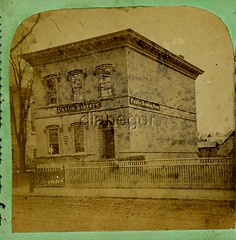
Great image.
Taunton MA, public library, stereoview detail, no date.
L.M. Maxham Real Photo Stereoview c.1870
Taunton Public Library
Wednesday, July 9, 2008
1966, Cruise Ship ex libris
.
STR. Lombok (?).
Books are lent -free of charge- to passengers and Officers daily between 10.00 and 10.30 a.m. and between 5.00 and 5.30 p.m.
One book at a time may be borrowed by each person for a maximum period of 7 days. An extension may be obtained upon application to the Chief Steward. All books should be returned before disembarkation.
The equivalent of Nf.10- will be charged for any book lost, damaged or defaced. If any book is received from the Library in a damaged condition, the Chief Steward should be notified immediately.
Received Into Ship's Library ___________ (Nov- 1966)
.
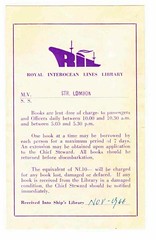
STR. Lombok (?).
Books are lent -free of charge- to passengers and Officers daily between 10.00 and 10.30 a.m. and between 5.00 and 5.30 p.m.
One book at a time may be borrowed by each person for a maximum period of 7 days. An extension may be obtained upon application to the Chief Steward. All books should be returned before disembarkation.
The equivalent of Nf.10- will be charged for any book lost, damaged or defaced. If any book is received from the Library in a damaged condition, the Chief Steward should be notified immediately.
Received Into Ship's Library ___________ (Nov- 1966)
.
Tuesday, July 8, 2008
Road to Monticello Review
 .
.What a week! Busy, but also very good. Well, true friend of the Bibliophiles of Oklahoma, Kevin J. Hayes's new book The Road to Monticello got a nice long review in the New York Sun this last week by Adam Kirsch. I mean to post a link to it then, but the holiday got in the way. So, read the review then go pick up a copy.
"The Jefferson we get to know in these pages, rather, is the voracious reader and book collector, the happy victim of what he called 'bibliomanie.'"
.
Subscribe to:
Posts (Atom)