Friday, June 27, 2008

Victory! Success! Super-Duper.

.


Wonderful. Amazing. Very Interesting. And they weren't talking about our digs. We actually didn't meet in the big house, but in the carriage house 'round back, which is still very nice, and actually better fitted for hosting these sort of events.

These were the words of folks who came out for the lecture by Dr. Kevin J. Hayes on the library of Patrick Henry. Dr. Hayes discussed what he had found about the patriot's library, and what his library can tell us about the personality of this enigmatic founding father. His findings will be published this fall in The Mind of a Patriot: Patrick Henry and the World of Ideas, from the University of Virginia Press. I don't want to give away the ending...

I was a little disappointed in the number of people, but we certainly did not lack enthusiasm and curiosity. Four of our regular members were there, one had an excused absence: being in another time zone half the summer. The others, unexcused. But, all told, we had double the bodies than we've had at any other meeting. And everyone was well behaved. I think everyone asked a question during Q & A, and no one threw anything or yelled obscenities. We also managed a couple of people who are interested in becoming full fledged members, which is wonderful. And FREE!

I had asked Mrs. Exile to buy some cookies for us at the store... she rolled her eyes and we wound up with homemade shortbread, pretty cupcakes and a fresh fruit spread to put a fancy downtown hotel's Sunday brunch buffet to shame. I put out cups, forgot to print the intro-bio of our speaker (managed to print it on some labels in the offices of our hosts), and almost forgot the drawing. Our winner Dr. LB (a *real* Dr. and wife of BoOK member Dr. RB) won the drawing and selected an old color catalog of maps going back to 17th century.

Putting on the event I learned a lot. We've not hosted one of these special scholarly nights before. I'm hoping to do these quarterly, with our regular casual meetings monthly. The presenter and content of our first one certainly set a high standard. I hope these will be hallmarks of our organization and our events.

One thing I learned, is that I did submit our (FREE) event to the different public radio stations in the area. That was helpful, as it was posted to their respective websites and they did play PSAs announcing our event. Well, one did for sure, as I heard it. I posted the event to other Community Calendar of Events type websites, including LibraryThing Local. However, LT only shows 50 LT users in a 25 mile radius of me. I live in Oklahoma City. Not exactly a low-population place.

I sent out multiple emails to the membership list I have. I did get one regret due to gas prices.

The most effective thing though was calling people and personally inviting them. If I got face-to-face with someone they came. Next time, we may need to set up a calling tree. Yikes. People hate those. But it works.

Also effective, folks who had read about the event right here on the blog.

I did manage to get a copy of Dr. Hayes's new book fresh off the press, The Road to Monticello, from Oxford University Press. I've only had time to dip into it over the weekend, and so far so good. The reviews have been positive, as expected. Here's a review from the Boston Globet his weekend of Road to Monticello.

So, to Dr. Hayes, a HUGE thank you for giving our night its guts. Thank you to our kind hosts at the Overholser Mansion.
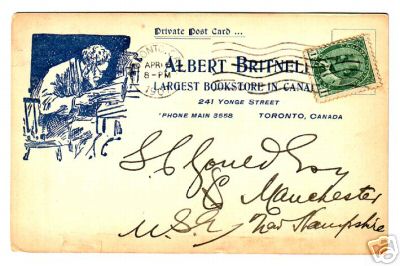

The envelope? No reason. I just like the man reading. 1907, from Albert Britnell, the Largest Bookstore in Canada.


.

Thursday, June 19, 2008

Huzzah! The Library of Patrick Henry


.

What are you doing June 26th, 7 pm? It's a Thursday. Looking for a FREE, bookish good time to get in the mood for Independence Day?

At the Overholser Mansion, there will be a talk given by one of the leading bibliographers in the US, Dr. Kevin J. Hayes, on the Library of Patrick Henry. The Mind of a Patriot: Patrick Henry and the World of Ideas, Dr. Hayes's newest book will be out in September from the University of Virginia Press.

Dr. Hayes has published bibliographies of the personal libraries of Benjamin Franklin, William Byrd and others. Also, his literary biography is out this month from Oxford University Press: The Road to Monticello: The Life and Mind of Thomas Jefferson.

The Overholser Mansion is located at 405 NW 15th St., in Oklahoma City. You can email me at benjaminlclark@gmail.com for any details you'd like. Feel free to invite anyone you think would be well behaved.

This FREE event is hosted by the Bibliophiles of Oklahoma, a club for book collectors, bibliographers, librarians, booksellers, book artists, writers, archivists and curators. All you need is a love of books.


.

Saturday, June 14, 2008

Nebraska to Texas to Massachusetts to Oklahoma....

.
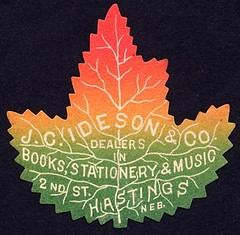
I've seen one of these style labels before, from Wesley Jones of Iowa. It has been digitally captured for the American Book Trade Index and can be found here.

I didn't realize when I saw the Jones piece it was a bookseller label. It was called a small trade card. I let it pass. I was later suspicious it was actually a label and my heart sank a little. You see, book trade labels are probably my favorite type of book trade ephemera. Anyway, although I am from Nebraska originally, I have never seen this label before and was thrilled to find it and add it to my album. For one, it's just purdy.

After a quick googleing, I hit on Ideson Library in Houston Texas. Named for one Julia Bedford Ideson, who just happened to have been born in Hastings, Nebraska. Now, Hastings is one of Nebraska's larger towns, but I doubt many Idesons lived there around the turn of the century, which is about when this label was in use. The one other of these die-cut leaf labels I've seen was ballparked to about 1890-1900. I don't think it's much of a stretch for the daughter of a bookman to become a librarian. Her short bio on HoustonHistory.com filled in some very helpful blanks.

Julia Bedford Ideson, is largely credited with developing the Houston public library system into the institution it is today. She was born on July 15, 1880, in Hastings, Nebraska, to Rosalie (Beasman) and John Castree Ideson. She attended Hastings public schools until 1891, when her father moved the family to Houston. After graduating from Houston public schools, she entered the University of Texas at Austin as a member of the first class to study library science at that institution.
So, the JC is John Castree and the label would be more appropriately dated to the 1880s-1890s, as the family had left in 1891. I wonder if Mr. Ideson continued to sell books in Houston? His daughter certainly continued a love of books. Even more about this fascinating woman can be found in a nice article in the Handbook of Texas Online.

After a little further investigation, I found a short blurb with a short bio on JC Ideson:
JOHN C. IDESON, of the firm of J. C. Ideson & Co., books, stationery, etc., was born in New York City in 1848, removing with his parents when quite young to Geneva, Ontario Co., N. Y., residing there with them until eighteen years of age. He was then employed as traveling salesman for a nursery for some six years. In 1872, he went to Houston, Tex., where he engaged in the stationery and book business in company with G. W. Baldwin. They carried on business together for five years, after which Mr. Ideson returned to his home in New York State. He came to Nebraska in 1878, and located in Hastings. He purchased 600 acres of land in Hamilton Co., Neb., and was engaged in improving the same until February, 1879, when he engaged in his present business in company with his brother, A. B. Ideson. He confines himself to the management of this business..."

The blurb on AB Ideson does not add any information to the book selling history we glean from JC's article. So, Mr. Ideson was moving to familiar territory when he went to Houston, Texas with a young family. Also, from this we can date the label starting in 1879 and ending in 1891. That's about as good as it gets...

.

Monday, June 9, 2008

Books in Arkansas!


.
Hooray! Not to disparage the Natural State, but this is the very first piece of book trade ephemera I've seen from Arkansas. Granted, I have not been specifically looking for ephemera from Arkansas, but nearly all states have a set within the American Book Trade Index. Even Mississippi! Not to dig on Mississippi... but it is Mississippi.

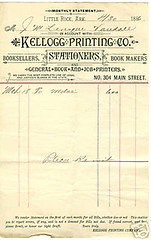
According to History of the Arkansas Press... by Frederick William, Jonathan Kellogg started his printing company in 1880 and closed in 1886. In that time he published the Arkansas School Journal which later became the Kellogg's Eclectic Monthly. Thanks Google Books! I didn't have that title on my shelf. It is also a very pretty billhead...

.

Wednesday, June 4, 2008

PS, Christopher Morley is still my Hero


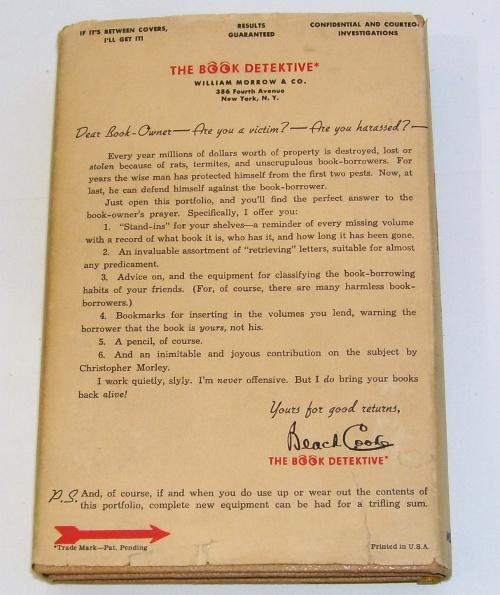
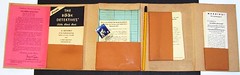
How could I forget the best part?! I was sure I loaded the photo of the interior of this marvel, but I guess I didn't. Here it is: The Interior of the Book Detektive (complete with pencil and foil label).

Enjoy!

.

Tuesday, June 3, 2008

Christopher Morley is my Hero

.
There. I've said it. Hold it against me if you wish, but I can't change. I won't. Christopher Morley is one of my heroes. Not only for the Parnassus on Wheels and Haunted Bookshop, which are fantastic, nor merely for his insight into the return of a book. I keep thinking if I could get it small enough, it would make a fine bookplate. With a tasteful border, of course.


" I give hearty and humble thanks for the safe return of this book, which having endured the perils of my friend's bookcase and the bookcases of my friend's friends, now returns to me in reasonably good condition. I give my hearty and humble thanks that my friend did not see fit to give this book to his infant for a plaything, nor use it as an ash tray for his burning cigar, nor as a teething-ring for his mastiff. When I loaned this book, I deemed it as lost; I was resigned to the business of a long parting; I never thought to look upon its pages again. But now that my book has come back to me, I rejoice and am exceedingly glad! Bring hither the fatted morocco and let us rebind the volume and set it on the shelf of honor, for this my book was lent and it is returned again. Presently, therefore, I may return some of the books I myself have borrowed."

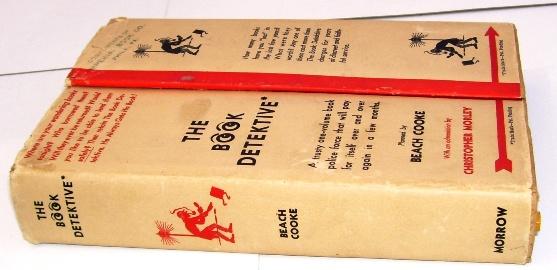
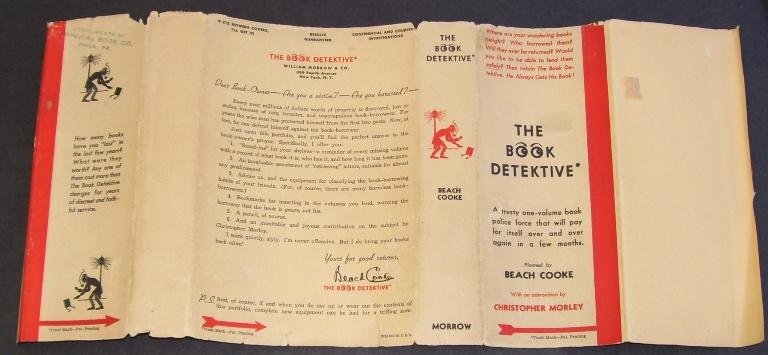
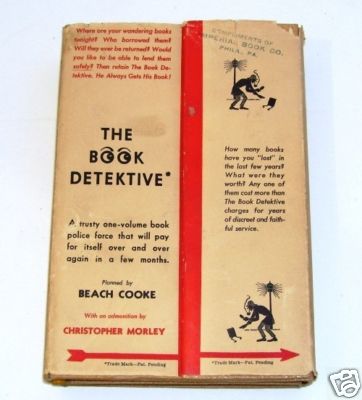
I truly admire the man for projects like The Book Detektive. The Book Detektive is a book shaped kit that could sit camouflaged in your bookcase and spring into action if a book were to be swept away in the moment of fool-hardy good hostmanship. That may not be a word. This is something I've had to learn how to deal with. I for one make it a point to say good-bye to books I "lend". In my experience (like Morley's), I *know* book borrowers have good intentions. Often have good intentions. Ok, it's rare... and they are deluding themselves. To the point, I've never seen one of these little kits until one crossed the counter at ebay. Well, the opening bid was somewhere around $70.00. If it had included more than one foil Book Detektive label, I would have faltered and bid to my ruin. However, I couldn't chase it past its closing price of $153 and change. Heartbroken, I browsed the venerable Bookfinder.com for a consolation copy. There seem to be two listed online. Both over $100. Only one lists the contents, and it doesn't sound as complete as the one on ebay.

Now I'll have to start that Morley collection, or start a collection of book reclamation systems. I wonder if there are others? Maybe I should market my own... Hmmm... THE EXILE BIBLIOPHILE PRESENTS....


The text of the auction for your benefit:.

THE BOOK DETEKTIVE A satirical item poking fun a people who borrow books and don’t return them!
Planned by Beach Cooke

With an admonition from Christopher Morley

Published by William Morrow & Co, NY copyright 1938. First Edition, 1st Printing.

Book shaped, folding box in a paper dust
jacket with red and black decorations and titles. The box is made of hard cardboard with a pebbled finish. The box size is 6 by 7 inches. Advertised as "A trusty one-volume book police force that will pay for itself over and over again in a few months". An unusual publication indeed. Consists of a multiple folding box with pockets for various items to help track and secure the return of loaned books.

Contains:

1) an 8 page booklet "The Little Black Book" with "a most important admonition by Christopher Morley being the hitherto unpublished transcript of the Criminal Trial of Pandowdy V. Librovore";
2) A card "Confidential Instructions for using The Book Detektive";
3) A card on "luring your books back diplomatically";
4) Cards for recording loaned books (3 red & 3 green);
5) Cards with sample letters to entice borrowers to return books (11 different);

6) bookmarks (22) with Christopher Morley quote.

7) one unused pencil

8) one unused foil ‘The Book Detektive’ Book Plate (label)


Condition: The box is in Near Fine condition in a Good dust jacket. The book covers are bright and clean; with only slight edge wear. The binding is tight, one of the foldable hinges beginning to crack all others hinges are firm with no cracks. The inside items above are in like new condition. There is a neat bookstore stamp on the front cover. There are no names, markings, tears or folds. The dust jacket is bright and clean with edge wear and small closed tears.


Monday, May 19, 2008

The bookseller that started Memorial Day

.
A classic from the Exile Bibliophile Archives in honor of Memorial Day. This Memorial Day I'll be participating in a ceremony at our Union Veterans Cemetery here in Oklahoma City. The public is welcome to attend. It will begin at 10:30 am Monday. The Union Cemetery is at NW 36th and MLK, close to the 45th Infantry Division Museum.

Memorial Day was typically a fun holiday for me and mine. It usually meant cookouts and warm weather. These don't always go together in Nebraska where I grew up. Every few years it would mean a sojourn out to the family cemetery to lay flowers on graves, mostly for people I never knew. I enjoyed the quiet graveyard by the little abandoned church and read the familiar names- names I had only heard in foggy stories. I liked trying to find the oldest markers, trying to decipher the military markers, and always stopping to admire the stone featuring a detailed drawing and patent number awarded to my kin for some kind of stump grinding devise.

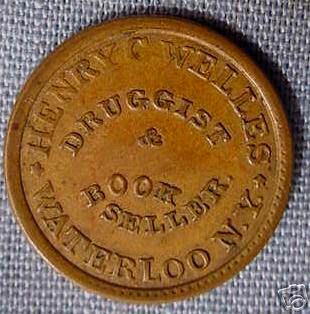
What does Memorial Day have to do with books? Henry Carter Welles was a hyphen bookseller. Not another Barber, but a more common Druggist-Bookseller. Welles, born in 1821, was too old to serve during the Civil War. Sure, there are many, many recorded volunteers who were in their 40s, and beyond, but it was not the norm. However, Mr. Welles, like the rest of the nation, was certainly thinking about the war and how many boys from home never returned.

At a social gathering in the summer of 1865, Welles suggested that a day should be set aside to honor the dead of the Civil War. The next year, he repeated his suggestion to General John B. Murray. The two men and a group of local citizens gained the support of the village, and on May 5, 1866, the first complete observance of Memorial Day took place in Waterloo, NY.

On that day, civic societies joined the procession led by veterans marching to martial music to the three existing cemeteries. At each cemetery there were impressive and lengthy services including speeches by General Murray and a local clergyman. The ceremonies were repeated on May 5, 1867.

Henry C. Welles died in July 1868, but had lived long enough to see Memorial Day nationally proclaimed by General John Logan, first commander of the Grand Army of the Republic. The GAR was the veteran's organization for Union vets of the Civil War. This was General Order No. 11 establishing “Decoration Day” as it was then known. The date of the order was May 5, 1868, exactly two years after Waterloo’s first observance. That year Waterloo joined other communities in the nation by having their ceremony on May 30.

The Centennial Committee, formed in Waterloo, New York for the 100th observance in 1966, found old newspapers from the 1860s honoring Henry C. Welles, crediting him for suggesting the first Memorial Day. Until that time it was believed that General Murray started Decoration Day.

So, we have one more to remember this Memorial Day. Henry C. Welles, the bookman who helped organize recognition for those who preserved our Union.

Pictured above is what coin collectors refer to as a store card. It's a token advertising a particular establishment, Mr. Welles in this case around 1861, minted these tokens. Tokens were widely used as small change, usually pennies during the Civil War since there was a shortage of official minted money. This was back when our change actually had intrinsic value, unlike today. So, merchants of all sorts saw an opportunity to spread the word about their particular business. However, the story goes, one saloon keeper in New York City took it too far and minted as many as one million tokens with his name and "Remit for 1 Cent". When the NYC streetcar company tried to remit the hundreds of thousands they'd received for fares, he told them to jump in a lake. They went to Congress, which created stricter laws about private citizens minting US currency.

.


.

Saturday, May 10, 2008

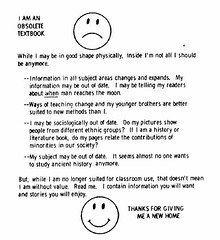
No one studies ancient history anymore

Received a small stack of old books, including a couple readers from the 1960s. One had this wonderful discard label inside the front cover. I got kick out of it and thought you would too.

Thursday, May 8, 2008

Bless me Ultima, Win an Altima!

.
One of the local library systems sponsored what I believe to be one of the most gimmicky and hilarious (and effective) reading promotions.

Barbara McCampbell of Norman stands next to the 2005 Altima she won by participating in The Bless Me, Ultima Ultimate Altima Giveaway sponsored by Bob Moore Auto Group and the Pioneer Library System as part of The Big Read. More than 1,200 readers entered the drawing for the car by participating in one or more of the 81 programs and book discussions about the Rudolfo Anaya classic Bless Me, Ultima presented by Pioneer Library System public libraries in Cleveland, McClain, and Pottawatomie counties.

McCampbell became eligible for the car by participating in an event at the Norman Public Library. The winning entry was drawn during a Cinco de Mayo celebration at Bob Moore Nissan in Norman that concluded the three-month reading promotion. The Big Read is sponsored nationally by the National Endowment for the Arts in partnership with the Institute of Museum and Library Services, and Arts Midwest.

Be sure to view all the Big Read Photos on Flickr!


.

Tuesday, May 6, 2008

Selling books in Baltimore


.
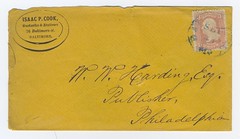
Undated cover, now in digital captivity at the American Book Trade Index.

Isaac P. Cook
Bookseller and Stationer
76 Baltimore St.

All inside a calligraphic swirly. Addressed to WW Harding, Publisher, Philadelphia.

A Baltimore City Directory places Cook at this address (actually W. Baltimore St.) in 1845.

Maryland Historical Society has further info:
COOK FAMILY PAPERS, MS. 2328
Land transactions of Isaac P. Cook (1808-84), Baltimore bookseller and stationer, and his wife, Laura (d. 1876), and daughter, Isabel (fl. 1877-87); correspondence, 1877-80, about property assessment; deeds for Baltimore City and County land, 1808-87.
47 items, 1808-87


Cover posted to ebay here. Sold for under $3. Very little. At that price, I should have grabbed it, but I thought it would go higher. I can always console myself it is out of my collecting area... but I don't feel any better about it...

WW Harding was bankrupt by 1878, according to this article from the NY Times.


.

Friday, April 25, 2008

1881 Detroit, Wilmer Brookes, printing bookstore


.
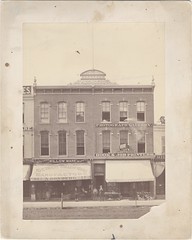
This wonderful photo hollers to us from about 1881. Brought to my attention by a constant contributor to the American Book Trade Index, Mr. WS. Thanks!! This is one of several from 19th Century Detroit.

If you visit the image on the ABTI you can see it at a larger than life level to see it ain't books out on the table on the walk there. What follows is the info posted on the Detroit Public Library's website, where this info was found.

Antonio Dondero's wicker furniture factory

Three-story brick building, with "A. Dondero" on pediment. Men and boys stand by wicker furniture and baskets on sidewalk. Signs on building read: Detroit Willow Ware Manuf'ry, A. Dondero; photograph gallery; Willmen & Brookes, book & job printers. Brick buildings on both sides. Embossed on photograph front: "B.F.R.B. (?)." Handwritten on mat back: "North side Monroe Ave. bet. Farrer & Randolph, about 1881."

1 photographic print mounted on mat board ; image 8.25 x 6 in.

Reproduction of photograph from the Burton Historical Collection

Courtesy: Detroit Public Library

.

Saturday, April 19, 2008

UCO Book Sale Report

.
Last night I attended the 8th annual FOL sale benefiting the University of Central Oklahoma Library. I've visited the UCO campus a couple times before, and never the library. So I started in the visitor lot (mistake) and wondered around. There are no maps posted, so I relied on the kindness of students hanging around to point the library out. The Max Chambers library is in the Northwestern quarter of campus.

It was friends day, so I joined at the door. Membership levels start at $5, which is quite a bargain! Books were shelved along general topical lines. You know, environmental law in gardening, etc. I arrived at the end of the evening, long after the afternoon rush, so it was a little rummaged, but I still found some great books. There was a good mix of newer and older, hardback and paperback, ex-library and donated. Prices are very reasonable, and of course, go to a good cause. Follow the link at the top of the post for all the nitty-gritty.

Also, I found a flyaway for the record books. Flyaways are the stuff found in books. Usually postcards, receipts, etc. Well, this was nothing like that. The book published 1889, in cloth with a shaken spine and hinges starting. There seemed to be a good sized pebble or something in the spine. I tried to peek down the back strip-- something was down there alright, but I couldn't see what. I delicately prodded it with my Parker Jotter popping the invader loose. It clunked out on the shelf-- a chocolate chip. Whole and unsullied. Weird.

.

Monday, April 14, 2008

1873, Webster's Dictionary ad


.
On this day April 14th, 1828 Noah Webster published the first edition of his dictionary. Webster at the age of 70, Webster published his American Dictionary of the English Language in two quarto volumes (with pages 19 cm (7 in.) wide[1] and roughly 25cm (10in.) tall) containing 70,000 entries. According to Wikipedia he did. I honestly don't know a lot about Webster's dictionary. I have enjoyed accounts of Samuel Johnson's dictionary, and Simon Winchester's The Meaning of Everything, the story of the OED. I've included another image from the American Book Trade Index, this time an ad for Webster's dictionary from an 1873 New Hampshire Farmer's Almanac. The dictionary was offered for $12!


.

Tuesday, April 8, 2008

Book Shop Cats

.
Why do all used book stores have cats? Don't tell me any reasons that explain how wonderful cats are. No. Cats are... well, they're a lot of things, but one thing for certain: they are not for me. People don't own cats, cats retain you for their staff.

I think at least half of all used book stores have cats. Stores without feline tenants are over compensated for as it is rare to find a catty bookstore without several creatures within. So, my conservative estimate is that there are at least 3 bookselling cats for every used and antiquarian book shop in North America. If you think you can escape cats in books about bookshops, well the ratio in fiction is at least 12:1! Now, this is all based on years of extensive research and a dislike of cats.

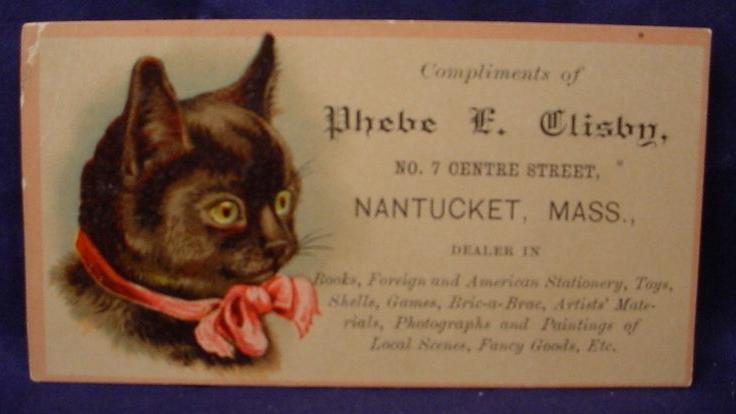
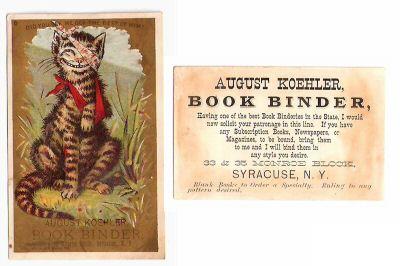
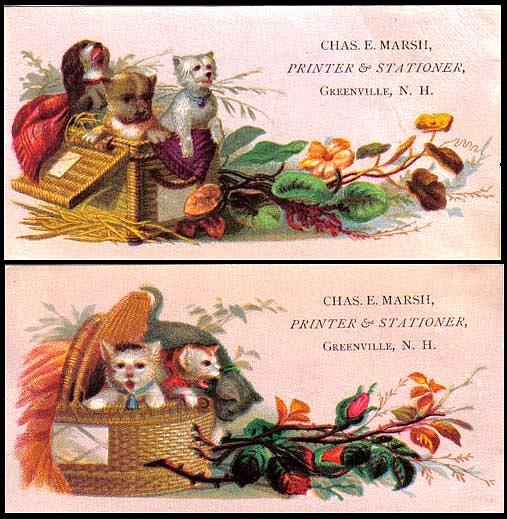
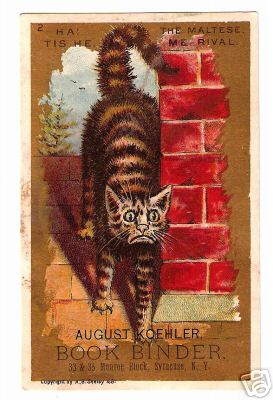
Before the bibliocommunity starts heating up the tar and plucking chickens, I offer these: 19th century trade cards featuring cats. These cats aren't too bad. They're mostly cute, they don't shed, don't make a racket or *ahem* mark territory.

Since nearly all of my readers (well, both of you) are "cat people" I post the following for your viewing pleasure. Of course, these are only a few contributions to the American Book Trade Index, which churns on. We are currently closing in on the 1800 image mark! Hooray!

Monday, March 31, 2008

Resist Temptation and Little Nips


.
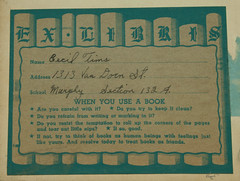
Brilliant. Another example of a bookplate carrying use and care instructions (and guilt trips). I love this. From JB, charter member of the Bibliophiles of Oklahoma. I forgot to ask is Cecil followed these rules...

When You Use A Book
* Are you careful with it?
* Do you try to keep it clean?
* Do you refrain from writing or marking in it?
* Do you resist the temptation to roll up the corners of the pages and tear out little nips?
* If so, good.
*If not, try to think of books as human begins with feelings just like yours. And resolve today to treat books as friends.

.